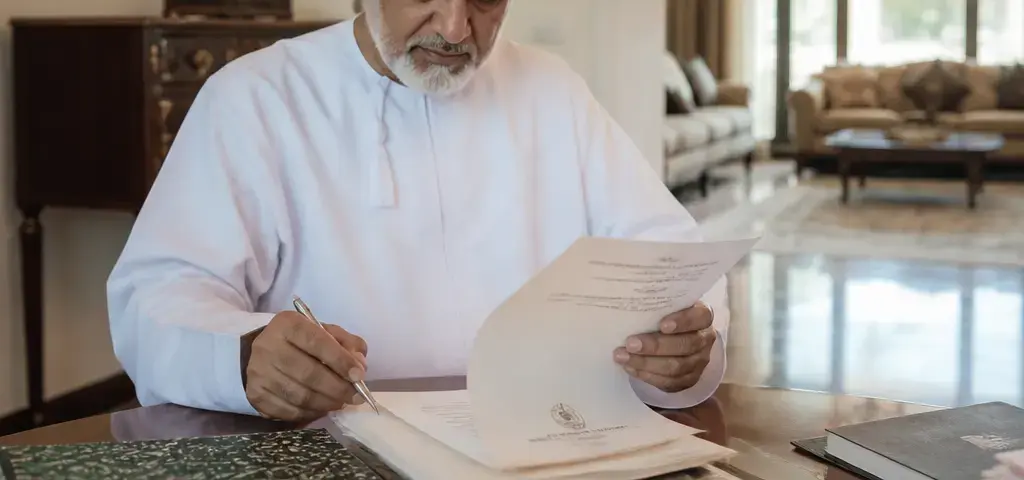
Oman Property Will for Foreigners: Do You Need a Separate Will?
For an Oman property will foreigners should not assume that a home-country will will transfer an ITC property without friction. The Ministry of Housing and Urban Planning lists 5 OMR to submit a title-registration request based on a will, 30 OMR to register the will for each property and 10 OMR for the new title deed.
A separate Oman will is not automatically required for every foreign owner. However, it is often the more practical estate-planning tool where an owner holds an Integrated Tourism Complex (ITC) property, has heirs in more than one country, or wants to prevent an Oman asset from being overlooked in a broad worldwide will.
The key distinction is between legal validity and operational clarity. A properly drafted home-country will may be relevant in Oman, particularly for a non-Muslim expatriate, but it can require certified Arabic translation, legalisation and supporting evidence. A locally coordinated document can reduce ambiguity, provided it does not contradict the owner’s wider estate plan.
The short answer: separate is usually sensible, not universally compulsory
What a separate Oman will is designed to solve
An Oman-specific will isolates Oman assets: the ITC home, local bank balances, furniture, vehicles and any locally held investments. It can name beneficiaries, identify an executor or local representative where appropriate, and make clear whether the document is intended to supplement rather than revoke a worldwide will.
For non-Muslim expatriates, Omani courts may recognise a will made under the law of the owner’s home jurisdiction. But formalities matter. Trowers & Hamlins notes that foreign wills may need witnessing, certified Arabic translation and legalisation before they can be used in Oman.
The official post-death title-registration service lists 45 OMR in stated public fees per property: 5 OMR for the request, 30 OMR for will registration and 10 OMR for the title deed. This is not the cost of drafting a will or obtaining legal advice.
On a practical level, we recommend a separate document when a global will uses broad language such as “all assets worldwide” but does not identify Oman property or the ownership structure. A cross-border estate plan should state clearly which will governs which assets and confirm that neither document accidentally revokes the other.
Worldwide will versus Oman-specific will
Compare scope before choosing the format
The choice is not always either-or. Many internationally mobile families use a worldwide will for assets in their home country and an Oman-specific will for local assets. The documents should be reviewed together by advisers qualified in the relevant jurisdictions. A will that is strong in one country can still create delay if its wording, signatures or revocation clause conflict with the second document.
An ITC property does not pass solely because a beneficiary is named in a will. The succession process and the beneficiary’s eligibility must still be checked under the applicable Oman and ITC rules.
Why ITC property needs its own succession review
Ownership rights and transfer are separate questions
Foreign ownership in Oman is concentrated in the ITC framework created by Royal Decree 12/2006. AIDA in Yiti is within this ownership framework, so inheritance planning should test both the wording of the will and the route for transferring title after death.
The official service for registering a title deed based on a will requires the existing title deed, a legal will, identity documents, legatee documents and, where applicable, agent documents. All legatees must be identified on the Ministry platform. If a legatee is a minor, that status must also be reflected through the real-estate registration offices and in the court-issued will.
The service page states a 1.0-day service duration, but that should not be read as a guaranteed end-to-end probate timetable. It describes the administrative service after the necessary legal documents are in place. If the property is mortgaged, approval from the mortgage holder is required to transfer the mortgage to the legatees; a lien also prevents the transfer.
Do not confuse succession charges with acquisition costs. For foreign buyers, the property-registration fee is 3% of the property value at completion. Residential first sales are subject to 5% VAT, while resale residential property is VAT-exempt. Those purchase-stage charges do not replace the post-death title-transfer process. For owners considering Aida Oceana Villas, this distinction belongs in the family’s ownership budget from the outset.
Who benefits most from a separate Oman will?
What to check before signing
First, confirm the legal owner shown on the title deed and whether the property is held solely, jointly or through another arrangement. Second, list every Oman asset that should be covered. Third, check that beneficiary names match passport records. Fourth, ask counsel to compare the Oman will with any existing worldwide will, marriage contract, trust arrangement or nomination form.
A typical family relocating to Muscat may spend more time assessing the home itself than the title structure. Our practical view is that two document reviews—one before purchase and one after completion—are more useful than trying to repair an unclear estate plan after a major life event. This applies equally to a buyer considering Trump Cliff Villas or another ITC residence.
For a foreign owner, the conclusion is straightforward: a separate Oman will is not a checkbox required in every case, but it is often the clearest way to organise an Oman estate. It is especially valuable where the family expects the property to stay within the family, where heirs live abroad, or where the owner already has a will drafted under another legal system.
Related reading: how foreign buyers register and verify a title deed, buying alone or with a partner, usufruct vs freehold in an ITC and using a power of attorney for an Oman property.
- Gov.om
- Ministry of Housing and Urban Planning
- Trowers & Hamlins
This article is general information, not legal, tax or succession advice. Before signing or changing a will, obtain advice from qualified lawyers in Oman and in the jurisdiction governing your existing estate plan.
Want to buy property in Oman? Explore our freehold residences →
Oman Property Will for Foreigners: FAQ
Do foreigners need a separate will for property in Oman?
Not in every case. A separate Oman will is often advisable where a foreign owner holds ITC property or has a worldwide will that does not clearly address Oman assets. It should be coordinated with the wider estate plan.
Can a foreign will be used for Oman property?
A foreign will may be relevant, particularly for a non-Muslim expatriate, but it can require formalities such as certified Arabic translation, legalisation and evidence of validity under the home jurisdiction’s law.
What are the official fees to register an Oman title deed based on a will?
The listed fees are 5 OMR for the request, 30 OMR to register the will for each property and 10 OMR for the title deed, for stated public fees of 45 OMR per property.
Can a minor inherit an ITC property in Oman?
The official service states that minor legatees must be registered through real-estate registration offices and identified in the will issued by the court. Specialist legal advice is important before naming a minor beneficiary.
Does naming an heir in a will guarantee an ITC property transfer?
No. A will records the owner’s intentions, but ITC succession and title-transfer requirements still apply. The title deed, legal will, beneficiary documents and any mortgage-holder approval must be addressed.