Sohar Property Investment: Should You Look North of Muscat?
Sohar property investment is supported by a growing industrial and logistics base: North Al Batinah’s residential price index rose 17.6% year on year in Q1 2026. Yet for an international buyer seeking freehold residential ownership, Muscat’s ITC market remains the more straightforward route because foreign nationals may buy land only inside Integrated Tourism Complexes.
Sohar has a credible economic story, but an investor should separate that story from the residential property purchase case. North Al Batinah recorded a 17.6% annual rise in its residential real estate price index in Q1 2026, while Sohar’s 2025 population reached 293,446 people, including 147,673 expatriates. These are meaningful demand signals. They do not, by themselves, create a broad freehold market for overseas residential buyers.
What is driving Sohar property investment?
An industrial economy with measurable expansion
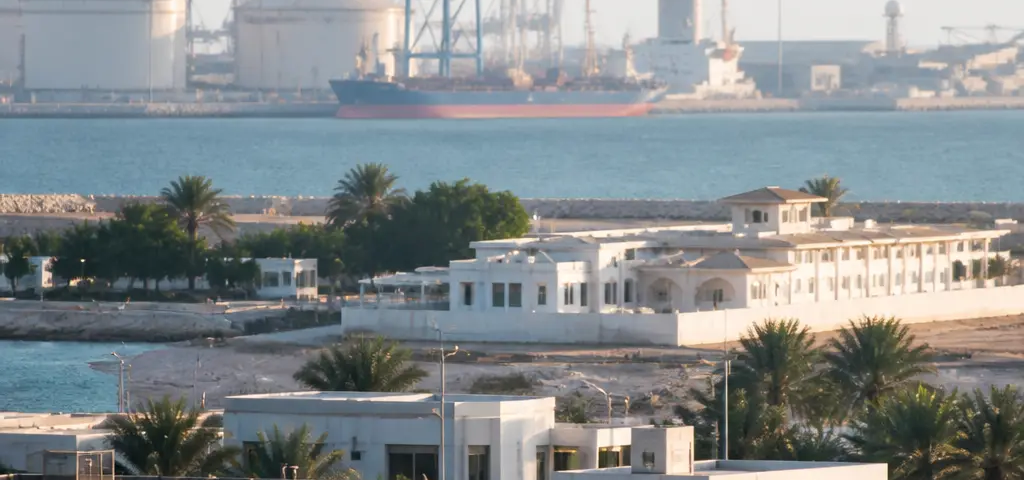
Sohar’s investment case starts with employment, trade and industrial activity rather than a resort or lifestyle proposition. SOHAR Freezone announced a USD 23 million expansion in April 2025, adding 500 hectares of leasable land. The plan includes 15 km of roads, 7.5 km of flood protection and 30 km of stormwater drainage. Its second phase is expected to add more than 2.5 million tonnes of annual throughput capacity.
The wider pipeline is also material. OPAZ reported that cumulative investment in Sohar Freezone rose from OMR 600 million at the end of 2023 to more than OMR 1.3 billion by the end of 2024. In 2025, the zone recorded a further 28% increase. In January 2026, OQ announced a PTA and PET manufacturing plant in SOHAR Freezone with investment above OMR 192 million and annual capacity of up to 700,000 tonnes.
For a residential investor, these figures matter because industrial expansion can support housing demand from managers, technical specialists, contractors and service businesses. But the demand profile is likely to be more employment-led and budget-sensitive than Muscat’s international lifestyle market.
Sohar’s population increased from 287,094 in 2024 to 293,446 in 2025, a gain of 6,352 people. The expatriate population alone rose by 3,154 over the same period.
Price momentum is not the same as liquidity
NCSI’s Q1 2026 index shows North Al Batinah residential real estate at 117.8, up 17.6% from Q1 2025 and 12.4% from Q4 2025. Muscat stood at 156.5, up 22.5% year on year and 29.5% quarter on quarter. These are index readings, not asking prices, rental yields or a forecast of future capital appreciation.
That distinction is essential. An index can show transaction-price movement across a governorate, while a buyer’s resale outcome depends on the specific property, title structure, buyer pool, building quality and timing. We recommend treating Sohar’s headline growth as a reason to investigate the local market, not as a substitute for a property-level exit strategy.
Sohar versus Muscat for an international residential buyer
Muscat is not one uniform market. Al Mouj Muscat, Muscat Bay, Muscat Hills, Jebel Sifah and AIDA in Yiti are active ITC locations around the capital area. Each has a different product mix, access pattern, community maturity and buyer profile. The key advantage is structural: an international purchaser can assess established residential projects designed for foreign ownership rather than trying to infer eligibility from Sohar’s industrial growth.
For buyers comparing northern Oman with the capital, the decision is therefore not simply “cheaper versus more expensive.” It is a choice between an economy-led local market and a deeper international residential market. A buyer planning to occupy the home, preserve resale flexibility and use Oman residency options should give legal structure and end-user demand as much weight as entry price.
Foreign nationals may purchase land only within Integrated Tourism Complexes. Do not assume that proximity to SOHAR Port, the freezone or a new factory gives a residential unit a foreign-buying route; confirm the title and eligibility before reserving a property.
Where AIDA Oceana fits in the comparison
A Muscat-area alternative for ownership-led demand
AIDA is an ITC in Yiti, Muscat, developed by DarGlobal and OMRAN. Its master plan covers more than 4.5 million m² across cliffs around 130 metres above sea level. This is a different thesis from Sohar: it targets a coastal, branded residential setting with access to Muscat rather than housing demand anchored primarily to industrial employment.
For buyers who prefer villas and a defined handover timetable, Trump Cliff Villas are a collection of three furnished three-bedroom villas, with layouts of 128 m² and 166 m² and prices from USD 1,007,363. The stated handover is Q4 2028, with the precise date fixed in the contract for the individual property. The project also includes Halo Villas, where the stated handover is Q4 2029 and the exact contractual date must likewise be checked for the chosen unit.
The comparison is not a claim that Muscat will outperform Sohar. It is about matching the asset to the buyer’s purpose. Sohar may suit an Omani or GCC buyer who understands local neighbourhoods and wants exposure to the industrial corridor; a similar logic applies to Salalah in the south, where demand follows tourism rather than industry. For many international purchasers, a Muscat ITC offers a more legible freehold framework, recognised residential communities and a clearer path to a future resale strategy.
Who should consider each market?
Practical conclusion: investigate Sohar, but do not substitute it for Muscat automatically
Sohar deserves attention because the economic base is expanding: its freezone is adding 500 hectares, OQ is backing an OMR 192 million manufacturing project, and the city’s population rose by 2.2% in 2025. Those are real fundamentals. They are strongest for an investor who can evaluate local micro-locations, tenant demand and title eligibility in detail.
In a typical decision scenario, a buyer planning permanent life in Oman benefits more from two inspection trips at different times of day than from a broad regional price comparison. Review driving time, community completion, retail access, the developer’s delivery record, building management and the realistic buyer pool on exit. If the objective is international freehold ownership in a coastal residential project near Muscat, start with Aida Oceana Villas and compare the available collections by contract terms, not by generic regional headlines.
Registration costs also need to sit in the underwriting. For foreign buyers, the property registration fee is 3% of the property value; a first sale of residential property is subject to 5% VAT. Budgeting should also include the OMR 5 application fee, OMR 25 non-Omani transaction-form fee, OMR 10 title-deed fee and OMR 2 contract fee where applicable.
Looking east rather than north? See our assessment of Sur property and its coastal potential.
- National Centre for Statistics and Information
- SOHAR Port and Freezone
- Public Authority for Special Economic Zones and Free Zones
- OQ
Information is for market orientation only, not legal, tax or investment advice. Verify ownership eligibility, VAT treatment, fees, financing and contractual handover terms with qualified advisers before signing.
Considering property in Oman? Explore Aida Oceana, our flagship project in Muscat →
Sohar Property Investment FAQ
Is Sohar a good place to invest in property in 2026?
Sohar has measurable industrial momentum: North Al Batinah’s residential price index rose 17.6% year on year in Q1 2026, while Sohar Freezone continues to expand. It may suit investors who understand local demand, but overseas residential buyers should first confirm title eligibility and resale liquidity.
Can foreigners buy property in Sohar?
Foreign nationals may purchase land only within Integrated Tourism Complexes in Oman. Before paying a reservation fee for a Sohar property, confirm that the individual unit and title structure qualify for foreign ownership.
Why is Muscat easier than Sohar for international property buyers?
Muscat has several established ITC locations, including Al Mouj Muscat, Muscat Bay, Muscat Hills, Jebel Sifah and AIDA in Yiti. These communities provide a clearer framework for foreign ownership than a generic residential property outside an ITC.
What registration costs should a foreign buyer budget for in Oman?
Foreign buyers pay a 3% registration fee on the property value. Additional fixed charges include OMR 5 for the application, OMR 25 for the non-Omani transaction form, OMR 10 for the title deed and OMR 2 for the contract. A first sale of residential property is subject to 5% VAT.
Does Sohar Freezone growth guarantee rental income for residential property?
No. Freezone and manufacturing investment can support local housing demand, but it does not guarantee occupancy, rental income or resale gains. Assess the exact location, tenant profile, competing supply, title eligibility and management costs for the individual property.