Duqm Property Investment: Industrial Growth, Workforce Housing and Muscat Alternatives
Duqm property investment is gaining attention because cumulative investment in the Special Economic Zone at Duqm exceeded RO 6.3 billion by 2025, while new energy, steel, logistics and workforce-housing projects continue to expand the local economic base. The trade-off is clear: Duqm is an industrial-growth thesis, whereas Muscat offers a broader residential market and established freehold options in ITCs.
Duqm is no longer assessed only as a long-horizon infrastructure story. The Duqm Refinery increased capacity to 255,000 barrels per day in 2025, and SEZAD has continued to sign projects across renewables, manufacturing, power and tourism. For investors, that changes the central question from “will activity arrive?” to “which property type and ownership structure can capture demand without taking on excessive execution risk?”
Why industrial activity is putting Duqm on investors’ radar
A growing base of operating and planned projects
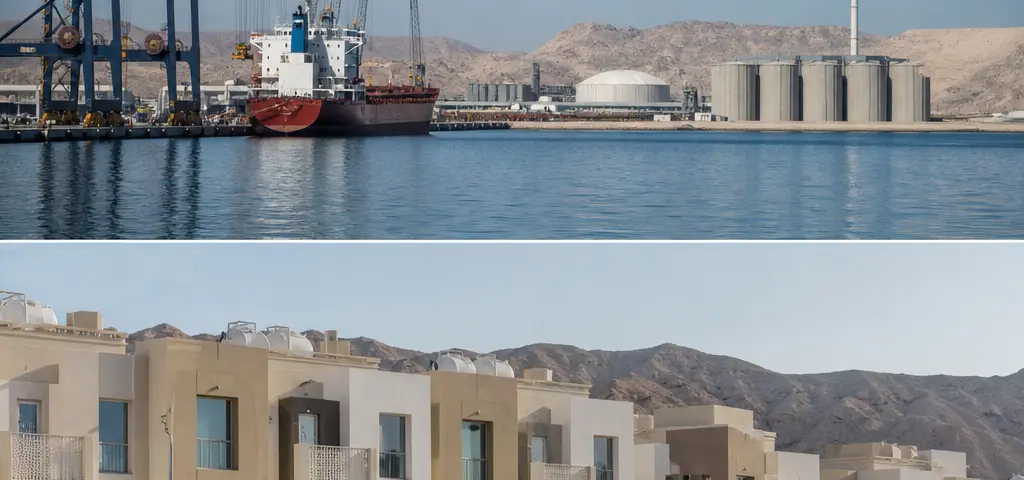
Duqm’s case rests on a cluster rather than a single asset. The refinery, Port of Duqm, dry dock, airport and logistics infrastructure support industrial occupiers, while OQ, Kuwait Petroleum International, ACME, Jindal Shadeed, Vale and Vulcan Green Steel are among the organisations linked to major projects or investment activity in the zone. SEZAD reported more than RO 6 billion of investment by February 2025; by the Duqm Economic Forum later that year, cumulative investment was reported above RO 6.3 billion.
The industrial pipeline remains substantial. In 2025, SEZAD signed a RO 70 million wind-turbine project. The ACME green hydrogen and green ammonia development covers 80 square kilometres in its second and third phases, with each phase expected to produce 71,000 tonnes of green hydrogen and 400,000 tonnes of green ammonia annually. These are not residential-property statistics, but they are measurable indicators of the corporate activity that can create demand for accommodation, services and local commercial space.
In June 2026, Jindal Shadeed Oman agreed to develop a US$78 million employee community with 500 housing units in Duqm. It is direct evidence of workforce-accommodation demand, but it does not prove a specific rental yield for privately owned homes.
Workforce housing is a real demand driver, not a yield guarantee
Investors often focus on specialist tenants: engineers, project managers, contractors, logistics staff and technical teams working on long-duration developments. That tenant base can support professionally managed housing near employment centres. The planned 500-unit Jindal community is therefore important because it confirms employers are actively addressing accommodation needs as industrial activity grows.
At the same time, company-built housing can compete with private landlords. A sound Duqm property investment underwriting model should test the employer mix, lease duration, transport requirements, furnishing standard and the amount of accommodation supplied directly by industrial companies. We recommend treating workforce demand as a location-specific rental thesis, not applying a generic Oman yield assumption.
Duqm versus Muscat: two different investment cases
Muscat and Duqm should not be treated as substitutes in every portfolio. A Muscat freehold home is usually a residential ownership decision with a wider buyer pool. Duqm is more sensitive to industrial milestones, workforce cycles and infrastructure delivery. Investors seeking a single stable residential base may prefer established Muscat communities; investors comfortable with a specialised, longer-cycle thesis may assign Duqm a smaller and more selective allocation.
Muscat provides an established freehold framework
Foreigners may buy land only within integrated tourism complexes, and foreign-buyer registration carries a 3% fee on the property value, plus fixed administrative charges. The first sale of residential real estate is subject to 5% VAT, while a residential resale is VAT-exempt. These rules are relevant when comparing a documented ITC purchase in Muscat with any opportunity marketed around Duqm: confirm the precise legal tenure before comparing headline prices or projected returns.
For buyers who want a residential alternative linked to Muscat, Aida Oceana Villas is positioned in Yiti, Muscat. Within the project, Trump Cliff Villas offers 30 three-bedroom villas measuring 129–166 m², with prices from OMR 385,380 and handover stated as Q4 2028; the exact handover date must be confirmed in the contract for the specific property.
Do not treat a project announcement as completed rental infrastructure. In Duqm, verify title or usufruct rights, zoning, handover status, utilities, property management and the source of tenants before committing capital.
What the latest project announcements mean for rental demand
New capital is broadening the economic mix
June 2026 agreements in Duqm included a US$500 million integrated industrial complex on one million square metres, a US$910 million 890MW power station with early commissioning expected in 2028 and commercial operation planned for 2029, a US$750 million natural-gas-liquids plant and a US$480 million tourism development with two hotels, retail and offices. The diversity matters: it reduces reliance on one refinery or one contractor, although none of these announcements removes development risk.
A practical scenario is an investor considering furnished accommodation for technical staff. The right first step is not to model an optimistic nightly or monthly rate. It is to map nearby employers, identify whether they house staff internally, and ask what lease length their contractors actually require. A second scenario is a buyer comparing a Duqm unit with a branded Muscat residence: two site visits at different times of day can reveal more about access, retail maturity and liveability than a brochure.
Supply matters as much as demand
New staff housing, hotels and mixed-use schemes can add both demand and competing supply. This is why a Duqm rental strategy should include vacancy assumptions, furnishing and maintenance costs, manager fees, and a resale plan that does not depend on a single employer. Investors should also separate long-term residential leasing from short-term accommodation: they serve different occupiers and can face different operating requirements.
Who should consider Duqm property investment?
Duqm can work as a focused satellite allocation, not necessarily as a replacement for Muscat residential ownership. The strongest case combines verified tenure, a location close to actual employment demand, realistic operating costs and a holding period that can absorb industrial-project timing.
For a residential route in Muscat, Marriott Residences has a stated handover of Dec 2028; the exact handover date must be confirmed in the contract for the specific property. This illustrates the difference between buying into a defined residential collection and underwriting an industrial-growth location.
Related reading: where Muscat property sits in a wider portfolio, how short and long-term rental scenarios compare, which locations carry demand through the year, and how infrastructure spending feeds into values.
- Special Economic Zone at Duqm
- Oman News Agency
- Public Authority for Special Economic Zones and Free Zones
Information is provided for general market context, not legal, tax or investment advice. Verify tenure, contractual terms, tax treatment and rental assumptions with qualified advisers before a purchase.
Interested in Oman real estate investment? Download the Aida Oceana project brochure →
Duqm Property Investment FAQ
Is Duqm property investment suitable for foreign investors?
It can be, but foreign investors should verify the exact tenure, permitted use, registration route and contractual protections for the individual asset before committing funds.
Why is Duqm attracting property investors?
The case is linked to industrial and logistics expansion. Cumulative investment in SEZAD exceeded RO 6.3 billion by 2025, supported by refinery, renewable-energy, manufacturing and infrastructure projects.
Does workforce housing guarantee rental income in Duqm?
No. The planned US$78 million Jindal employee community with 500 units confirms accommodation demand, but company housing can also compete with privately owned rental homes.
How does Duqm compare with Muscat for property investment?
Duqm is more exposed to industrial-project delivery and specialist workforce demand. Muscat has a broader residential tenant and buyer base, with foreign ownership available in designated ITCs.
What costs should foreign buyers consider in Oman?
For foreign buyers, property registration is 3% of the property value, plus fixed administrative charges. The first sale of residential real estate is subject to 5% VAT, while a residential resale is VAT-exempt.