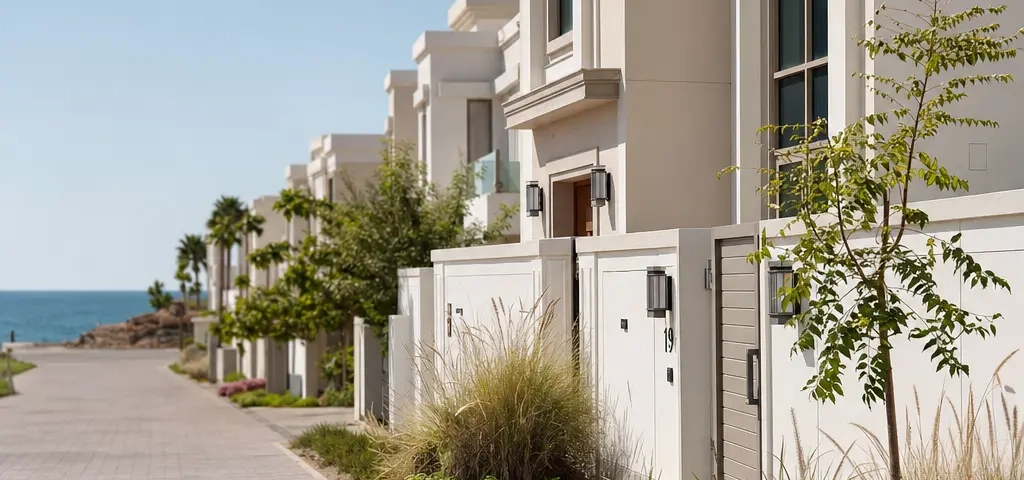
Real Estate Investment Oman: ROI, Taxes and the Numbers That Matter
Muscat residential yields are typically quoted around 5.5%–6.8% gross in 2026, while Oman still offers no recurring annual residential property tax. For foreign buyers using approved freehold structures in Integrated Tourism Complexes, the investment case depends less on tax sheltering and more on entry price, holding costs, handover timing, and realistic net yield after fees.
In 2026, the most important fact for anyone looking at real estate investment Oman is simple: the market is attractive because total ownership friction remains relatively low, not because returns are automatic. Public and market data place gross residential yields in Muscat at about 5.45% in the city centre, 5.97% outside the centre, and around 6.8% on broader market estimates, depending on unit type and location. That is the starting point for any ROI model, not the finish line.
We also need to separate Oman into two investor realities. One is the wider market, where ownership rules differ by asset and location. Our overview of what foreigners can buy in Oman sets out where access applies. The other is approved freehold stock in Integrated Tourism Complexes, where non-Omanis can own property directly. For the mechanics, see how freehold ownership works. That is the legal framework behind projects such as Al Mouj Muscat, Muscat Hills, Hawana Salalah, and AIDA in Yiti. For a project-level comparison, see how Muscat Hills compares with AIDA. Within AIDA, products such as Marriott Golf Residences, Halo Villas, and Aida Oceana Villas fit the freehold, lifestyle-led segment international buyers usually target.
What ROI in Oman really means in 2026
Gross yield is the easiest number to quote and the easiest number to misuse. Global Property Guide explains gross rental yield as annual rent divided by purchase price before costs. In Muscat, public-facing yield references for 2026 cluster in the mid-single digits: 5.45% in central areas, 5.97% outside central areas, and roughly 6%–7% in broader market estimates depending on property size and submarket.
A gross yield of 6% on a property priced at OMR 200,000 implies about OMR 12,000 in annual rent before service charges, maintenance, vacancy, management, and acquisition costs.
Gross yield vs net yield
For most investors, the useful spread is not 5% versus 7%. It is gross yield versus net cash yield after friction. Oman does not levy personal income tax on residential rental income under the current system for individual investors, and it does not impose a recurring annual residential property tax. That helps preserve net income. But net yield still moves lower once you factor in service charges, maintenance reserves, furnishing, leasing downtime, and agency fees.
In practice, we advise modelling three scenarios. A conservative case might haircut headline gross yield by 1.5–2.0 percentage points. A stabilized case may reduce it by around 1.0–1.5 points. A premium branded asset with stronger occupancy and resale appeal may defend pricing better, but the entry basis is also higher. That is why two units with the same 6% gross yield can deliver very different IRR outcomes over a 5-year hold.
Capital appreciation is location-specific
Price growth in Oman is not uniform. Muscat remains the country’s most liquid residential market, and Yiti has drawn attention because of master-planned resort-led development. Public market references place mainstream Muscat apartment pricing around OMR 600–1,220 per sq m in 2026, with a reported city-centre average of OMR 1,023 per sq m. Premium integrated communities can price materially above that, especially when the asset includes sea views, golf positioning, hospitality branding, or restricted freehold stock.
For investors, that means appreciation should be underwritten from supply quality and buyer pool depth, not broad national averages. In our view, the strongest Oman strategies are usually built around exit liquidity: who will buy the unit from you in 3–7 years, and at what basis relative to replacement cost?
Taxes and transaction costs: what you actually pay
Oman remains more straightforward than many regional markets, but “tax-light” does not mean “cost-free.” For a clean acquisition model, investors should track at least four layers of cost.
1) Property transfer and registration
Market guidance used by foreign-buyer advisers consistently points to a transfer or registration cost of about 3% of property value on acquisition. On a purchase of OMR 250,000, that alone means roughly OMR 7,500 in one-time government registration cost, before financing or furnishing.
2) Mortgage registration
If financing is used, the government mortgage registration fee is 0.5% of the property value, according to the official service page. There are also small fixed charges listed on the same service: OMR 5 for application submission, OMR 2 for mortgage contract fees, and OMR 10 to print ownership documents.
At OMR 300,000, the official 0.5% mortgage registration fee adds OMR 1,500 before bank-specific arrangement charges.
3) VAT treatment
VAT in Oman is 5%, but residential real estate needs careful interpretation. The Tax Authority states that certain residential property transactions, including resales and leases, are exempt from VAT. Its real-estate manual adds an important distinction: the first supply of a residential property is subject to 5% VAT, while the resale of a residential property is exempt. It also states that qualifying residential rental is exempt when the occupation period is more than 3 months and structured under relevant tenancy rules.
That creates a practical difference between buying off-plan or newly delivered stock and buying resale stock. It also means short-stay inventory, serviced apartments, hotel-style stock, and some mixed-use assets should be underwritten differently.
Investors often hear “Oman property is VAT-free.” That is not precise. Residential resale and qualifying long-term residential leases are exempt, but first supply of residential property is subject to 5% VAT, and service charges may also attract 5% VAT depending on structure.
4) Ongoing annual taxes
For direct individual ownership, Oman does not impose annual residential property tax, and the current system does not tax individual residential rental income in the same way many Western markets do. That is one reason gross-to-net slippage can be lower than in high-tax jurisdictions. The main annual drag is therefore operational rather than fiscal: maintenance, sinking fund exposure, furnishing refresh, and community charges.
Foreign ownership, residency, and approved structures
Foreign ownership is central to the Oman investment story. The official government service confirms that non-Omanis can own real estate in tourist complexes, which is the functional route international buyers use for freehold residential exposure. The Ministry of Housing and Urban Planning administers this framework.
For residency, official Invest Oman guidance says property investment from OMR 200,000 can qualify under the Golden Residency route, granting a renewable 10-year permit while the qualifying property is held. For buyers below that level, the two-year owner visa route has no minimum property value inside an ITC. The family side of the same calculation is covered in our guide to family residency in Oman after a home purchase. Because residency rules have evolved, we recommend checking the live government portal at the point of purchase rather than relying on broker summaries. We walk through the process in Oman residency through property.
This matters because the residency angle changes ROI behaviour. The 10-year route is set out in our Oman Golden Visa guide. Buyers at OMR 200,000 and above are not always yield-maximizers. Some are combining lifestyle use, family planning, GCC diversification, and long-term residency optionality. That broadens the resale pool for well-positioned freehold stock, especially in master-planned coastal projects.
Where the numbers look most investable
In Oman, we would segment opportunities into four broad buckets: mainstream Muscat apartments, premium freehold apartments, branded residences, and villas in destination-led master plans. Each has a different return profile.
Mainstream apartments
These are usually the clearest income plays. Entry pricing in broader Muscat remains lower, and publicly cited yields near 5.5%–6.8% gross are easier to support when units target working professionals and long-term tenants. Current furnished apartment rents in Muscat show what those tenants actually pay. The trade-off is weaker scarcity value and less international resale visibility.
Premium freehold and branded stock
This is where buyers pay for legal clarity, master-plan quality, hospitality adjacency, and international buyer demand. Communities associated with OMRAN, DarGlobal, Al Mouj Muscat, Eagle Hills Muscat, and Muriya/Orascom have shaped much of the conversation around internationally marketable Omani property. Yields may not always be the highest on paper, but capital preservation and exit depth can be stronger. For the brand-premium question specifically, see whether Marriott and Trump branded residences justify their pricing. The same discipline applies to hotel residences investment in Oman, where owner income depends on the operating agreement rather than headline hotel data.
AIDA and Yiti positioning
AIDA sits in Yiti, a coastal area southeast of central Muscat. Public developer-linked pricing references indicate AIDA entry pricing from about US$422,000, while some Yiti villa marketing references cite starting levels from roughly OMR 168,000 and project handover windows around Q4 2028 for selected stock. We would treat exact unit pricing as inventory-specific, but the strategic point is clear: AIDA is being positioned in the premium freehold bracket rather than the mass-income bracket. Assets such as Trump Golf Villas or Fairway Villas therefore need to be judged on blended ROI: lifestyle demand, resale strategy, and long-term scarcity, not rent alone.
Our assessment: when Oman works best as an investment
We see the strongest case for Oman when investors want a tax-efficient, politically stable GCC market with straightforward freehold access in designated projects and realistic mid-single-digit gross yields. Invest Oman highlights FDI stock of US$78.78 billion in 2025 and notes the Omani rial’s peg to the US dollar, both relevant for currency-sensitive international buyers.
From experience, buyers who do best in Oman usually avoid two mistakes. First, they do not underwrite premium coastal stock as if it were a pure cash-yield apartment block. Second, they do not ignore acquisition friction: 3% transfer cost, possible 5% VAT on first supply, 0.5% mortgage registration, and the impact of handover timing can materially change year-one ROI.
We have also seen expat buyers start by comparing Oman with Dubai on headline appreciation and then recalibrate quickly. We lay out that comparison in Oman vs UAE for investors. Oman is a different proposition. The appeal is steadier entry pricing, simpler annual tax exposure, and selective scarcity in approved freehold zones. If your priority is balanced GCC diversification rather than the most aggressive short-cycle growth story, that can be a rational allocation.
Disclaimer: This article is for general market information only and is not legal, tax, or investment advice. Rules on VAT, residency, title structure, and financing should be checked against the latest official guidance before reservation or transfer.
Interested in Oman property investment? Download the Aida Oceana project brochure →
For a closer look at how VAT, corporate rates and the 2028 personal income tax shape net returns, see our review of Oman real estate tax benefits.
FAQ: Real Estate Investment in Oman
What rental yield can investors expect from residential property in Oman in 2026?
Public 2026 market references for Muscat cluster around 5.45% gross in central areas, 5.97% outside the centre, and roughly 6%–7% in broader market estimates depending on unit type, location, and purchase basis.
Does Oman charge annual property tax on residential real estate?
No recurring annual residential property tax is generally applied in Oman. For individual investors, the bigger cost items are usually transfer fees, possible VAT on first supply, service charges, maintenance, and vacancy.
Is VAT payable when buying property in Oman?
It depends on the transaction. The first supply of residential property is subject to 5% VAT, while the resale of residential property is exempt. Qualifying long-term residential leases are also exempt, but hotel-style and short-term stays are not treated the same way.
Can foreigners buy freehold property in Oman?
Yes, non-Omanis can buy property in approved Integrated Tourism Complexes. This is the main freehold route used by expatriates and international investors in projects such as AIDA, Al Mouj Muscat, Muscat Hills, and Hawana Salalah.
What are the main transaction costs when investing in Oman real estate?
Investors should usually model around 3% for transfer or registration cost, 0.5% of property value for mortgage registration if financing is used, and possible 5% VAT if the purchase is a first supply of residential property. Small fixed administrative fees may apply as well.
Can buying property in Oman help with residency?
Official Invest Oman guidance states that property investment from OMR 200,000 can qualify under the Golden Residency route, granting a renewable 10-year permit. Buyers should confirm current rules on the official portal before purchase.