Yiti Infrastructure Projects: What Could Drive Property Values in the Coming Years
Yiti infrastructure projects matter because access and resilience are central to pricing in a coastal, mountain-edge location. The 720-metre Yankit Mountain Road on the Yiti–Al Sifah route cut the slope by about 40 metres, while wider Muscat transport investment can support the area’s long-term appeal without guaranteeing price growth.
Yiti infrastructure projects are becoming a more practical investment question than a speculative headline. For buyers looking at Yiti, the key issue is not whether a new road alone will raise values, but whether a package of safer access, tourism capacity and master-planned residential development expands the pool of residents, second-home buyers and visitors over time.
What is changing around Yiti
Local road upgrades improve the Yiti–Al Sifah corridor
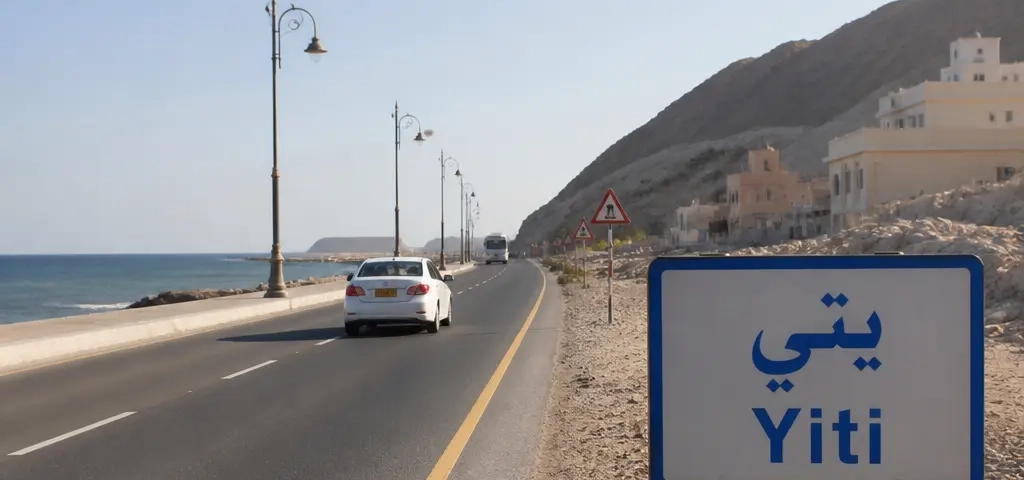
Muscat Municipality has opened the Yankit Mountain Road on the Yiti–Al Sifah route. The new section is 720 metres long and 10 metres wide. It required about 250,000 cubic metres of excavation to reduce the gradient by roughly 40 metres. The scheme also includes two reinforced-concrete wadi crossings with a combined length of 300 metres and side protection.
For real estate, that matters more than a headline about a “new road”. Mountain and coastal routes are judged by daily usability, road geometry, drainage and perceived safety. Better all-weather access can improve the practical appeal of Yiti for owner-occupiers and for people comparing a coastal residence with more established Muscat communities.
A larger link remains a catalyst to monitor, not a completed fact
Muscat Municipality has also described an Al Amerat–Wadi Al Mih–Yiti route prepared for a future phase. Its published concept is a 16-kilometre dual carriageway with two lanes in each direction, serving the villages along Wadi Al Mih. The route is intended to support tourism and development in the wider Yiti area.
That distinction is important. A proposed corridor can influence land-market expectations, but it should not be priced as if it were operational. We recommend treating the 16-kilometre route as an upside scenario until there is a confirmed procurement, construction timetable and opening date.
Master-planned development is adding residential critical mass
Yiti is also the site of The Sustainable City – Yiti, a joint venture between OMRAN Group and Diamond Developers within the first phase of the Yiti master plan. The published scheme covers about 1 million m² and includes 1,657 residential units, among them 300 villas. For buyers, the relevance is scale: a master-planned community of that size brings services, utilities and future residents into the same coastal corridor, rather than leaving Yiti an isolated resort pocket.
The completed Yankit Mountain Road is an observable access improvement: 720 metres in length, 10 metres in width and about 40 metres less slope than the previous alignment.
How Yiti infrastructure projects may affect capitalisation
Infrastructure affects property values through three channels: lower perceived access friction, a broader buyer catchment and improved confidence that public services can support long-term occupation. It does not set prices by itself. Supply, payment plans, handover quality, operating costs and the legal ownership structure remain equally important.
At city level, the infrastructure backdrop is also material. Oman Airports states that Muscat International Airport has Stage 1 capacity for 20 million passengers annually and a terminal area of 580,000 m². In the first half of 2025, the airport handled 6.23 million passengers and 44,743 flights. These figures do not measure Yiti demand directly, but they show the scale of the gateway serving international purchasers and visitors.
Tourism data adds a useful reality check. NCSI data shows occupancy in Oman’s three- to five-star hotels reached 56.7% in 2025, up from 49.9% in 2024, while December 2025 occupancy in Muscat’s classified three- to five-star hotels reached 76.0%. The gap between the annual average and the December peak points to strong seasonality rather than a straight-line growth story. Investors should therefore model rental demand conservatively rather than extrapolating peak-season occupancy into annual income.
Why the wider Muscat network still matters to Yiti
Yiti is not an isolated resort market; it is part of Muscat’s eastern coastal geography. In February 2026, the Authority for Projects, Tenders and Local Content awarded contracts worth more than OMR 186.3 million for the Muscat Expressway expansion from Qurum Natural Park Interchange to Halban (over OMR 157.2 million) and for the Al-Yahmadi–Al-Qafisi Ibra Road dualisation (OMR 29.1 million). Neither award is a Yiti-specific budget. Still, it signals continuing public investment in the wider road network that connects employment districts, airport access and residential catchments.
AIDA sits in Yiti on cliffs around 130 metres above sea level, within a master plan of more than 4.5 million m². DarGlobal and OMRAN are the development partners, with Trump Golf and Marriott among the project brands. The master-plan phases are stated for Q3 2028, Q3 2029 and Q4 2030; these are master-plan phase timings, not handover dates for every individual collection.
For buyers comparing residential formats, Halo Villas and Marriott Residences illustrate how a master-planned setting can combine private residential use with amenity-led positioning. The investment case should still begin with the specific unit, its outlook, built-up area, payment schedule and contractual handover terms.
Do not capitalise an unbuilt road into today’s purchase price. The published 16-kilometre Al Amerat–Wadi Al Mih–Yiti concept is a project to monitor, while the 720-metre Yankit Mountain Road is the completed access improvement.
What buyers should price into a Yiti purchase
Transaction costs and ownership structure
Infrastructure is only one part of total acquisition cost. For a first sale of residential property in Oman, VAT is 5%. Foreign buyers pay a 3% property-registration fee at completion, plus fixed administrative charges. Foreign ownership is available inside integrated tourism complexes, while land purchases by foreigners are restricted to ITCs. These costs should sit in the initial cash-flow model rather than being treated as a later legal detail.
For a qualifying owner of a residential unit in an ITC, Oman offers a two-year residency visa, with a 50 OMR issuance fee. Eligibility and application conditions still need to be checked at the time of filing. Residency can support personal-use demand, but it should not be confused with a return forecast.
Build an evidence-based price view
A typical buyer planning to live in Muscat gains more from two test journeys between central Muscat and Yiti at different times of day than from a generic location map. Check the route after dark, assess roadworks and confirm how the property functions during hot months as well as the main visitor season.
For an investment-led purchase, compare the project with established ITCs such as Al Mouj Muscat, Muscat Bay, Muscat Hills and Jebel Sifah, but avoid assuming that their liquidity or rental depth transfers directly to Yiti. A smaller, emerging coastal submarket may offer differentiation, yet resale timing can be less predictable. Trump Cliff Villas are scheduled for Q4 2028; for any other collection, confirm the individual handover date in the contract rather than relying on a master-plan phase.
Who should follow this infrastructure story
The central conclusion is measured: Yiti infrastructure projects can strengthen the area’s relative accessibility and support capitalisation over time, particularly when road resilience, airport capacity and master-plan delivery move together. They are not a substitute for unit-level due diligence, realistic exit assumptions or a full cost model.
Related reading: how to weigh delivery risk when buying before completion.
Related reading: what the dollar peg, oil and rates mean for buying property in Oman.
For the wider planning picture beyond Yiti, see how Sultan Haitham City is reshaping what Muscat buyers expect from infrastructure and neighbourhood delivery.
For a contrasting case of infrastructure-led growth, see what industrial investment has done for Duqm.
- Muscat Municipality
- Oman Airports
- National Centre for Statistics and Information
- Authority for Projects, Tenders and Local Content
- OMRAN Group
This article is market commentary, not a valuation, legal or tax opinion. Verify road status, project delivery terms, eligibility and unit-specific costs in current official and contractual documents.
Considering property in Oman? Explore Aida Oceana, our flagship project in Muscat →
Yiti Infrastructure Projects FAQ
What are the main Yiti infrastructure projects to watch?
The completed Yankit Mountain Road on the Yiti–Al Sifah route is a current access improvement. Muscat Municipality has also published a concept for a 16-kilometre Al Amerat–Wadi Al Mih–Yiti dual-carriageway route, but buyers should monitor its confirmed execution status.
How long is the Yankit Mountain Road in Yiti?
The road is 720 metres long and 10 metres wide. Muscat Municipality states that the route reduced the slope by about 40 metres and includes two reinforced-concrete wadi crossings totalling 300 metres.
Can Yiti infrastructure projects increase property values?
They can support capitalisation by improving access, safety and buyer confidence, but they do not guarantee price growth. Supply, unit quality, payment terms, service costs and resale liquidity remain important.
What wider Muscat projects matter to Yiti buyers?
Muscat International Airport has Stage 1 capacity for 20 million passengers annually, while road contracts worth more than OMR 186.3 million awarded in February 2026 cover Muscat Expressway expansion and Ibra Road dualisation. These are wider-market drivers rather than Yiti-specific projects.
What costs should foreign buyers include when purchasing in Yiti?
For a first residential sale, include 5% VAT and a 3% property-registration fee for foreign buyers at completion, alongside fixed administrative charges and project-specific service fees.