Close ×
Expat Family Outside A Modern Hospital In Muscat, Oman

Healthcare in Oman for Expats: Hospitals, Insurance and Typical Costs

At a glance

Oman’s healthcare system combines a large public network with a deep private sector, and expats usually rely on employer-backed insurance plus private hospitals in Muscat. In 2026, practical entry-level costs are still manageable by Gulf standards: the resident-card medical examination costs OMR 30 (OMR 40 for food-sector workers), report attestation adds OMR 2–5, while private check-up packages in Oman are advertised from OMR 35 to OMR 70.

As of April 2026, Oman’s Ministry of Health had published its Health Reality and Figures 2025 statistical report, while the private market continued to expand through operators such as Aster Royal Al Raffah Hospital, Badr Al Samaa, Burjeel and Muscat Private Hospital. For expats, the key point is simple: everyday care is accessible, but the real difference comes from where you live, which insurance network your employer provides, and how quickly you can reach Muscat’s main hospital clusters.

If you are planning a long-term move rather than a short stay, healthcare should sit next to housing on your checklist. In our experience, expat families usually shortlist schools first and only then realise that commute time to a reliable hospital matters just as much. That is one reason buyers looking at integrated communities in Yiti often compare lifestyle, road access and healthcare logistics together when reviewing homes such as Marriott Golf Residences or Aida Oceana Villas.

How the healthcare system works for expats in Oman

Oman has a strong state healthcare framework, but expats should not assume they will use it in the same way as Omani nationals. In practice, most expatriates depend on private clinics and hospitals, especially in Muscat, because employer-sponsored insurance generally channels treatment into private provider networks.

Worth knowing

Insurance products compliant with Oman’s Unified Health Insurance Policy — the mandatory “Dhamani” scheme — were issued on the market with validity from 1 January 2026, now overseen by the Financial Services Authority (FSA, formerly the Capital Market Authority). That matters because expat coverage is now structured more formally than it was a few years ago.

There are also health formalities attached to residency. The Ministry of Health updated its medical fitness guidance for expatriates on 8 January 2026, and its pre-arrival medical report attestation service states fees of OMR 2 for Wafid eReport holders and OMR 5 for medical reports issued from medical centres in Oman for a change to a work visa. The medical fitness examination itself is billed separately: Gov.om’s service page (updated 2 July 2026) lists OMR 30 for non-catering workers and OMR 40 for food-service workers, with the form valid for 30 days from issuance.

For visitors rather than residents, Oman’s entry rules also matter. The Foreign Ministry’s visitor guidance states that a visitor should have health insurance, a return ticket, confirmed accommodation and enough funds for the stay. If you are arriving first on a visit visa and converting your plan later, that distinction matters.

Which hospitals do expats in Muscat usually use?

For day-to-day private care in and around Muscat, expats usually look at a mix of large hospital brands and specialist centres. The names that come up most often are Aster Royal Al Raffah Hospital in Al Ghubrah, Badr Al Samaa in Ruwi and Al Khuwair, Burjeel’s Oman-linked network for specialist pathways, Muscat Private Hospital, and the Ministry of Health referral hospitals for public care when relevant.

Major private providers to know

Aster Royal Al Raffah Hospital, Muscat lists 175 beds, 150+ doctors and 100+ specialities on its current hospital profile. For a newly arriving family, that scale matters because it improves the odds of keeping diagnostics, specialist review and follow-up in one network.

Badr Al Samaa describes itself as one of the largest private healthcare groups in the GCC, with around 25 hospitals and medical centres across Oman, Bahrain, the UAE and Kuwait. Its Oman footprint spans locations including Ruwi, Al Khoud, Sohar, Salalah, Barka, Sur, Nizwa, Suwaiq and Duqm, which is useful if your work takes you outside central Muscat.

We also watch how expats choose care in practice: singles often prioritise speed and insurer approval, while families usually want paediatrics, obstetrics and emergency access in one place. If you plan to live along the Yiti-Muscat coastal axis, drive times become part of the healthcare equation in the same way they do for schools, retail and airport access. That is part of the wider appeal of master-planned options such as Halo Villas and The Great Escape 2.

What health insurance do expats need in Oman?

For employed expats, the practical answer is employer-backed private cover. The compliance framework is now clearer than before: Allianz Care’s Oman employee benefit guide for 2026 states that its plans are compliant with the Unified Health Insurance Policy (Dhamani), now regulated by the Financial Services Authority (FSA, formerly the Capital Market Authority), and that guide is valid from 1 January 2026. In other words, the market is working around a defined regulatory template, not informal employer discretion alone.

When reviewing a policy, focus less on headline marketing and more on five operating points: inpatient cap, outpatient limit, maternity waiting period, co-pay structure, and network geography. A policy can look fine on paper and still be inconvenient if it excludes your nearest hospital or requires repeated pre-authorisation for common diagnostics.

Worth knowing

For short-stay visitors, Oman’s official visitor guidance says health insurance is part of the expected entry documentation. For residents on employment pathways, visa-linked medical procedures also carry official fees: OMR 30–40 for the medical examination depending on occupation, plus OMR 2–5 for report attestation depending on the document route.

Families should also ask whether the plan includes chronic condition management, vaccination reimbursement and direct billing. These are the items that shape everyday life more than one-off emergency cover. To see how the medical line sits alongside rent, schooling and transport, compare it with our 2026 household budget for Muscat.

What healthcare actually costs in Oman

Published price transparency in Oman is still uneven, so the safest way to estimate costs is to rely on official fees and clearly listed provider packages rather than inventing a full tariff sheet. Even with that limitation, several useful benchmarks are public.

Badr Al Samaa’s Oman wellness listings currently show a Master Health Check Up at OMR 70 and an Executive Body Check Up at OMR 35. Those are not substitutes for insurance, but they are useful anchors for understanding the cost of preventative private care.

On the administrative side, the Ministry of Health lists OMR 2 for Wafid eReport holders and OMR 5 for medical reports issued from medical centres in Oman when changing to a work visa. That is a small item individually, but it is a real cost that many first-time expats overlook. The medical fitness examination for the resident card is a separate line: OMR 30 for non-catering workers and OMR 40 for catering staff, per Gov.om. If you are still planning the wider move, our first 30-day checklist for new Muscat residents puts these steps in order.

We would treat the rest of the market this way: GP and specialist consultations in Muscat are usually more affordable than in Dubai or Doha, but inpatient bills can still rise quickly if your policy has sub-limits or excludes a preferred hospital. The smart move is to ask your insurer for the live network list and your hospital for a written estimate before elective treatment.

Watch out for

Do not assume every private hospital in Muscat will accept your insurer on a direct-billing basis. A policy can be compliant in 2026 and still have network restrictions, pre-authorisation rules or exclusions that shift more cost back to you.

What expats should prioritise before moving

The best healthcare decision is often made before you ever need a doctor. Start with location. If you are moving with children, shortlist homes based on realistic drive times to your preferred private hospital, not only beach access or school catchment. Then confirm whether your insurer supports direct billing at that facility.

We also recommend keeping copies of passports, residence cards, insurance cards and vaccination records in one digital folder. That saves time during school enrolment, visa processing and emergency admissions. Setting up a bank account in Oman belongs on the same early checklist.

For buyers relocating to Oman rather than renting indefinitely, the same planning logic applies to housing. A home that works for work, schools and healthcare usually performs better as a long-term lifestyle asset. In Yiti, that is why buyers often compare integrated villa options such as Sunrise Haven Luxury Villas when assessing daily convenience, not just views.

Healthcare access in Oman is solid for expats who plan well. The system is not frictionless, but it is navigable if you match your insurance network, your family needs and your residential location from the start.

For families, healthcare sits alongside education in the relocation budget — compare options in our review of international schools in Muscat with 2026 fee schedules.

Sources
  • Ministry of Health Oman
  • Gov.om
  • Financial Services Authority (FSA) Oman
  • Allianz Care
  • Badr Al Samaa Hospitals
  • Aster Oman
  • Foreign Ministry of Oman

This article is for general guidance and reflects publicly available information reviewed in July 2026. Insurance terms, provider networks, visa rules and hospital pricing can change, so confirm details directly with the insurer, healthcare provider and relevant Omani authority before making medical or relocation decisions.

Planning a move to Oman? Our team can help you choose the right home →

FAQ: Healthcare in Oman for Expats

Is health insurance mandatory for expats in Oman?

For expats on employment pathways, private health coverage is typically arranged through the employer under Oman’s regulated insurance framework. For visitors, Oman’s official entry guidance also states that health insurance should be part of the travel documentation.

How much is the medical test fee for expats in Oman?

Per Gov.om (updated 2 July 2026), the medical fitness examination for the resident card costs OMR 30 for non-catering workers and OMR 40 for food-service workers. Report attestation is a separate Ministry of Health fee: OMR 2 for Wafid eReport holders and OMR 5 for medical reports issued from medical centres in Oman.

What are the main private hospitals for expats in Muscat?

Common names expats look at in Muscat include Aster Royal Al Raffah Hospital, Badr Al Samaa, Burjeel-linked specialist pathways and Muscat Private Hospital. Aster Royal Al Raffah Hospital in Muscat lists 175 beds, 150+ doctors and 100+ specialities.

How much does a private health check cost in Oman?

Published package pricing varies by provider and scope. Badr Al Samaa’s Oman wellness listings show an Executive Body Check Up at OMR 35 and a Master Health Check Up at OMR 70, giving a practical benchmark for private preventative care.

Can expats use public hospitals in Oman?

Oman has a large public healthcare system, but most expats rely more heavily on private hospitals and clinics through employer-sponsored insurance networks, especially in Muscat. Access in practice depends on residency status, employer arrangements and the type of care needed.

Related reading: another early-weeks essential is getting mobile — see our guide to driving in Oman: licences, rules and insurance.
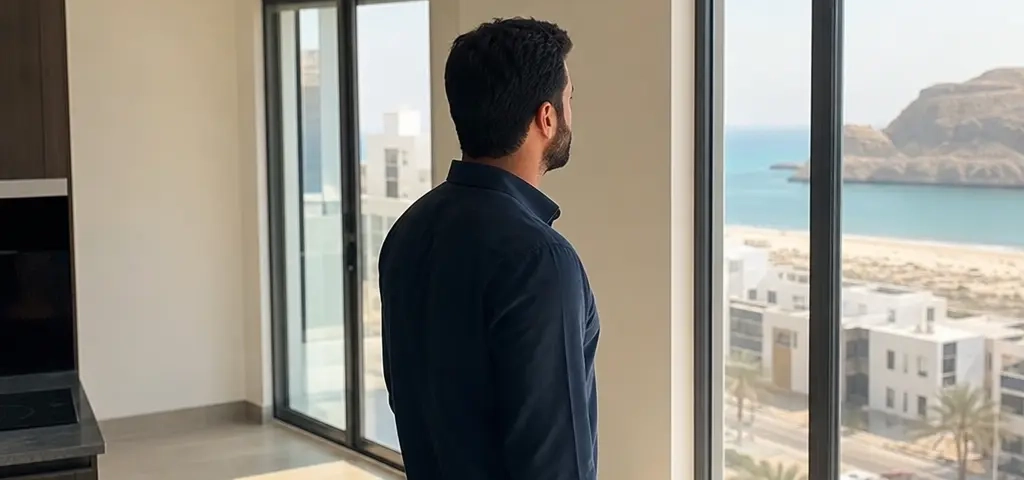
Buyer Comparing A Studio And One-Bedroom Apartment In Muscat With A Coastal Yiti Backdrop

Should You Buy a Studio or a One Bedroom Apartment in Muscat?

At a glance

As of 2026, entry pricing for apartment stock connected to the AIDA/Yiti market starts from about OMR 74,000 in nearby Yiti comparables, while inside AIDA the entry one-bedroom apartment (The Great Escape) starts from around OMR 86,000 (about AED 820,000). AIDA does not offer studios at all — its smallest format is a hotel room in the Trump-branded hotel. In our view, buyers choosing between a studio and a one bedroom apartment in Muscat should compare not just ticket size, but visa eligibility, resale depth, and rental yield, which for prime lifestyle-led stock typically sits in a mid-single-digit gross range. The operating side of that number is covered in our comparison of short-term and long-term rental scenarios in Oman.

In Muscat, the decision between a studio and a one-bedroom apartment in Muscat is mostly a capital allocation question. Market evidence from 2025-2026 shows a wide spread between mainstream apartment entry points and prime freehold resort-style inventory. That matters because small-unit buyers usually optimize for one of three outcomes: lower upfront cost, easier leasing, or a cleaner resale strategy.

We see the strongest demand concentrated in established and lifestyle-oriented parts of the capital such as Al Mouj Muscat, Muscat Hills, Yiti, and the new integrated tourism complex pipeline. For a district-by-district breakdown, see our guide to Muscat areas and prices. That is also why buyers looking at compact formats often end up comparing central Muscat apartments with master-planned options around AIDA. For example, The Great Escape 2 and Marriott Golf Residences appeal to purchasers who want a branded or destination-led asset rather than a purely budget unit.

Worth knowing

Foreign buyers can hold freehold title in licensed Integrated Tourism Complexes in Oman, and the current government service fee for a residential property owner visa is OMR 50 for a visa valid for two years.

What the numbers say in 2026

The first filter is budget. Publicly marketed comparables show nearby Yiti stock from OMR 74,000 for studios and smaller apartments, while AIDA’s entry one-bedroom apartment (The Great Escape) has been advertised from OMR 86,000 (about AED 820,000). AIDA itself does not sell studios — the smallest format there is a hotel room in the Trump-branded hotel. That is not an apples-to-apples comparison, but it shows the price ladder a buyer faces when moving from a basic studio to a master-planned, internationally branded coastal environment.

On the rental side, Hamptons’ 2025 annual market report shows average asking rent for a two-bedroom unfurnished apartment in Al Mouj Muscat at OMR 700 per month in Q4 2025 and OMR 715 in Q1 2026. In Muscat Hills, the same series stands at OMR 450 in Q4 2025 and OMR 470 in Q1 2026. Those figures matter because they help frame what compact units can realistically earn in prime versus mid-market locations. For a fuller area-by-area picture, see Muscat rent prices by area.

The Al Mouj and Muscat Hills figures above are for two-bedroom units, so they set an upper reference for prime rent rather than a direct read on a one-bedroom. Dividing a two-bedroom rent by a one-bedroom price would overstate the yield, so it should be avoided. Against AIDA’s entry one-bedroom price of around OMR 86,000, the correct input is a sourced one-bedroom rent — which sits below the two-bedroom benchmark — and that points to a mid-single-digit gross yield rather than an aggressive headline number.

We would also keep transaction costs in view. Oman still operates with a 3% one-time registration fee on purchase, while mortgage registration on Gov.om is listed at OMR 7 plus 0.5% of the property price. For leveraged buyers, that slightly changes the real acquisition cost. For the full return picture, see yields and taxes on Oman property.

Studio vs one bedroom apartment in Muscat: how buyers usually choose

When a studio makes more sense

A studio usually works better when the buyer wants the lowest possible entry ticket, simplified furnishing, and a wider tenant pool among single professionals. In nearby Yiti comparables, the from OMR 74,000 starting point is the clearest example of why studios attract first-time overseas buyers. If your strategy is to test the Muscat market with less capital, the smaller format is the easier way in.

We have also seen expat buyers prefer studios when they expect partial personal use rather than full-time occupancy. In that case, operational simplicity matters more than squeezing the last basis point of yield.

When a one-bedroom apartment works better

A one-bedroom apartment usually gives you a more flexible exit. It can suit a single executive, a couple, or an owner-occupier who plans to relocate later. That broader demand base often helps liquidity on resale, especially in prime projects where the buyer profile is more international.

There is also a residency threshold issue. Marketed information for AIDA-linked stock notes that long-term investor residency frameworks are discussed around OMR 250,000 for five years and OMR 500,000 for ten years under investment pathways, while the standard property-owner residence visa in an ITC is a separate two-year route. In practice, that means a one-bedroom or larger unit is more likely than a studio to sit near strategic thresholds, depending on the project and final contract value.

Watch out for

Do not assume every compact unit qualifies equally for every residency route. In Oman, visa type, project status, ownership structure, and final purchase price all matter, so buyers should confirm the exact pathway before reserving a unit.

Why freehold location matters more than bedroom count

For international buyers, location structure is often more important than whether the unit is a studio or one bedroom. Under Oman’s Integrated Tourism Complex framework, non-Omani buyers may own property in licensed ITCs. The legal basis dates back to Royal Decree 12/2006, and the market continues to expand with new tourism-linked developments.

That is important because Muscat is not one uniform apartment market. Al Mouj Muscat remains one of the most established freehold benchmarks. AIDA in Yiti is positioned differently: coastal, destination-led, and built around a 3.5 million sq m masterplan with hospitality and golf components. The developers and stakeholders that appear repeatedly in current Oman market research include Dar Global, OMRAN Group, Al Mouj Muscat, Muriya, and Eagle Hills Muscat. Buyers comparing small units should know who is behind the scheme, not just the floor area.

Within AIDA, projects such as Halo Villas, Aida Oceana Villas, and the residential pipeline around the golf and hotel components show how the area is being positioned for long-term value, tourism demand, and resale visibility.

Our practical view for expats and investors

We would frame the decision this way. If your maximum budget sits below OMR 60,000, a studio in a comparable Yiti or secondary Muscat location is the practical route. Once your budget reaches the OMR 86,000+ band, the conversation changes: at that level AIDA’s entry one-bedroom (The Great Escape) comes into range, and you are no longer buying only square meters — you are buying legal structure, community quality, and a better long-term buyer pool.

From our side, the safer logic for many overseas purchasers is that a one-bedroom unit is easier to hold over a full cycle. It tends to match more tenant profiles, works better for future owner occupation, and may align more naturally with residency planning. A studio can still make sense, but mainly where entry price is the priority.

We have seen this in real buyer behavior. One expat couple we advised started by looking only at the cheapest possible apartment in Muscat. After comparing service charges, resale depth, and visa implications, they shifted toward a larger format because the extra capital bought more flexibility. Another investor focused on yield chose the smaller unit because the lower basis reduced exposure and simplified furnishing. Both decisions were rational; the difference was strategy.

Bottom line

If your goal is the lowest-cost market entry, a studio is the cleaner answer. If your goal is a more resilient asset in Muscat’s freehold segment, a one-bedroom apartment is usually the stronger fit. In 2026, the key numbers to watch are OMR 74,000 as an entry-level nearby comparable, OMR 86,000 (about AED 820,000) as AIDA’s marketed entry one-bedroom price, OMR 650-715 monthly prime rent benchmarks from late 2025 to Q1 2026, the 3% registration fee, and the OMR 7 + 0.5% mortgage registration charge.

This article is for informational purposes only and should not be treated as legal, tax, immigration, or mortgage advice. Pricing, availability, residency rules, and developer terms can change, so buyers should confirm final conditions before signing a reservation or SPA.

💼
Income-focused buyer
Target gross yield: 3.7-4.1%
Best suited to buyers comparing prime Muscat rent benchmarks against purchase price. Prioritize leaseability, furnishing cost, and service-charge efficiency.
🌍
Expat planning residency
Visa fee: OMR 50, validity: 2 years
A one-bedroom unit often gives more flexibility for personal use and future relocation. Check ITC eligibility and visa route before reserving.
📈
Resale-oriented buyer
Entry 1-bed: from OMR 86,000
For buyers thinking ahead to resale strategy, broader end-user demand often favors one-bedroom layouts in established freehold destinations.

Related reading: weighing a villa against an apartment in Muscat

Whichever layout you choose, our pre-purchase checklist for Muscat covers tenure, fees and handover questions worth asking first.

Sources
  • Gov.om
  • Royal Oman Police
  • Ministry of Housing and Urban Planning
  • Hamptons Oman
  • Whitewill Oman
  • Ministry of Heritage and Tourism

Want to buy property in Oman? Explore our freehold residences →

FAQ: buying a studio or one bedroom apartment in Muscat

Is it better to buy a studio or a one bedroom apartment in Muscat?

It depends on strategy. A studio usually lowers entry cost, while a one-bedroom apartment often has broader tenant and resale demand. In 2026 market comparables, studios in the wider Yiti and Muscat catchment start well below AIDA, while AIDA’s entry one-bedroom (The Great Escape) has appeared from around OMR 86,000 (about AED 820,000); AIDA itself does not offer studios.

How much does a one bedroom apartment in Muscat cost?

Pricing varies sharply by location and legal structure. In AIDA, the entry one-bedroom (The Great Escape) starts from around OMR 86,000 (about AED 820,000), while smaller studios in the wider Muscat and Yiti catchment start materially lower.

What rental yield can I expect from a small apartment in Muscat?

Using prime benchmarks and current marketed entry prices, a realistic gross range is around 3.7-4.1% rather than an aggressive headline number. Actual yield depends on furnishing, vacancy, service charges, and whether the unit is in a prime freehold destination.

Can foreigners buy a one bedroom apartment in Muscat?

Yes, foreign buyers can own property in licensed Integrated Tourism Complexes in Oman under the existing legal framework. Buyers should verify that the project is within an eligible freehold structure before signing.

What are the main buying costs for apartments in Muscat?

The key official costs referenced in current sources are a 3% one-time registration fee on purchase and, if financing is used, a mortgage registration fee of OMR 7 plus 0.5% of the property price.

Oman Real Estate Market Overview In 2026 With A Focus On Muscat And Yiti

Oman Real Estate Market Report 2026: Market Review and Outlook

At a glance

Oman’s real estate price index rose 15.9% year on year in Q1 2026, while total trading value reached OMR 678.1 million by the end of March 2026, up 18.4% from a year earlier. For investors, 2026 looks like a market driven by tighter prime supply in Muscat, stronger pricing in approved freehold zones, and gradual demand growth tied to non-oil economic expansion.

In Q1 2026, Oman’s real estate price index increased by 15.9% year on year, according to National Centre for Statistics and Information data reported by Oman News Agency. Residential property prices rose 17.6%, with residential land up 21%, apartments up 4.4%, and villas up 9%. That matters because it shows the 2025 rebound did not fade at the start of 2026; it broadened into a stronger pricing cycle, especially in Muscat.

What is driving the Oman property market in 2026

The headline trend is simple: transaction activity and pricing are both moving up. By the end of March 2026, Oman’s total real estate trading value reached OMR 678.1 million, compared with OMR 572.7 million a year earlier, an 18.4% increase. Earlier in the year, the traded value for January 2026 alone was OMR 235.8 million, up 27.1% from January 2025. In other words, momentum was already visible before the latest quarterly price data confirmed it.

Macro conditions are supportive rather than overheated. The IMF projected Oman’s GDP growth at 2.8% for 2025 and said growth should strengthen further from 2026 as non-hydrocarbon activity expands. Inflation is expected to stay slightly above 1% in the near term. For property investors, that combination usually supports real asset demand without the kind of inflation shock that can destabilise financing.

Worth knowing

Muscat recorded the strongest residential land price growth in the country in both Q4 2025 and Q1 2026: +41.3% and +43.6% year on year respectively. In practice, that keeps prime Muscat locations at the centre of investor attention.

We also look at financing conditions closely. In Muscat, Numbeo’s February 2026 dataset showed a typical 20-year fixed mortgage rate around 5.25%, with a market range of roughly 4.5% to 6.0%. One major local lender, National Bank of Oman, also lists a 0.5% mortgage creation charge payable to the Ministry of Housing. That does not define the whole market, but it helps frame realistic acquisition costs.

Why Muscat matters most

Muscat remains the core pricing reference point for international buyers. As of February 2026, reported apartment prices in Muscat averaged about OMR 1,023 per sq m in the city centre, with an observed range of OMR 600 to OMR 1,220 per sq m. Outside the centre, the average was about OMR 598 per sq m, with a range of OMR 459 to OMR 688.5 per sq m. Reported gross rental yields were 5.45% in central areas and 5.97% outside the centre.

That pricing is still moderate compared with many Gulf luxury markets, but the spread is wide. In our view, the premium is increasingly paid for community infrastructure, legal clarity on title, and destination quality, not just unit size. That is why branded and master-planned schemes continue to attract attention.

How 2025 set up the 2026 market

The 2026 upswing did not appear from nowhere. Oman’s residential property price index rose 7.3% in Q1 2025, then accelerated to 18.7% in Q3 2025 and 14.6% in Q4 2025. Apartment prices were especially strong in Q3 2025, rising 22.4% year on year, while villa prices in Q4 2025 increased 20.6%. By the time Q1 2026 arrived, the market had already built a clear base of demand.

At the same time, transaction volumes and mortgage activity pointed to better liquidity. By the end of April 2025, total real estate transaction value had reached OMR 833.9 million, up 9.7% year on year, while mortgage contract value rose 6.1% to about OMR 421.5 million across 7,164 contracts. By the end of July 2025, total traded value had climbed further to OMR 1.593 billion.

One detail investors should not ignore: the number of issued ownership title deeds fell to 45,789 by the end of March 2026 from 55,378 a year earlier, down 17.3%. We read that as a sign that value growth is outpacing pure transaction count growth, especially in higher-ticket segments.

Watch out for

Not every part of Oman is moving in the same direction. In Q1 2026, North Sharqiyah residential land prices fell 14.9% year on year, while several governorates posted only low single-digit gains. Market selection matters more in 2026 than broad country-level averages suggest.

Where international capital is concentrating

For foreign buyers, the legal map is still selective. In 2026, freehold ownership for non-Omanis remains concentrated in approved Integrated Tourism Complexes, while some projects may use usufruct structures depending on the development framework. A practical threshold to know is residency-linked investment: several market guides in 2026 reference a renewable five-year residency route from property valued above OMR 250,000. We always recommend checking the title structure and residency pathway on the specific project, not just the district.

The legal backdrop is also evolving. Royal Decree 79/2025 introduced a broader law regulating real estate, and a new Real Estate Registry Law came into effect on 18 May 2026. That reform cycle matters because it points to more formalised registration, clearer title evidence, and better sector infrastructure over time.

The names shaping the market

Investors looking at Oman in 2026 will repeatedly encounter a small group of real operators. OMRAN Group remains central to tourism-led destination development. DarGlobal is a major name in premium branded residential projects. Muriya, the OMRAN-Orascom joint venture, continues to operate integrated resort towns such as Jebel Sifah and Hawana Salalah, with total investment cited at $750 million. Eagle Hills Muscat is behind The Residences at Mandarin Oriental, Muscat. Al Mouj Muscat also remains one of the country’s best-known master-planned references for international buyers.

For Yiti and greater Muscat specifically, AIDA matters because it sits at the intersection of lifestyle positioning and foreign-buyer demand. DarGlobal says AIDA spans 3.5 million sq m, is being developed with OMRAN, and targets first-phase completion in Q3 2028. Main works on The Great Escape apartments and AIDA Phase 1 villas were awarded with handover targeted for Q3 2028. Within the same master plan, branded components include the Trump International Hotel, Trump Golf Villas, and Marriott Golf Residences.

Our 2026 outlook for Oman real estate

Our base case is for the Oman market to stay positive through 2026, but with a more selective pattern than the headline index suggests. Prime Muscat and structured freehold communities should continue to outperform secondary stock. Based on current Muscat pricing, reported gross yields around 5.4% to 6.0%, mortgage rates around 4.5% to 6.0%, and still-low inflation, the market remains investable for buyers who prioritise title quality, community delivery, and exit depth.

We do not expect every asset class to move at the same pace. Commercial property rose 10.5% in Q1 2026, below the 17.6% gain in residential. Retail shop prices even fell 1.8%. For that reason, investors focused on capital appreciation should keep most attention on well-located residential product, especially villas, branded residences, and master-planned coastal communities. On the branded-residence side, our comparison of Trump and Marriott hotel residences looks at how those two brands price and perform.

From our side, the most practical strategy in 2026 is not to chase the entire country. It is to compare a small number of legally clear, professionally managed schemes in Muscat and Yiti, then underwrite for a realistic hold period. We have seen expat buyers start with a broad Oman search and narrow quickly once they compare title structure, handover timing, service quality, and resale liquidity. That is also why products such as Halo Villas or Aida Oceana Villas tend to enter the conversation only after the legal and market fundamentals make sense.

📈
Yield-focused investor
Gross yields about 5.4%–6.0%
Best suited to buyers comparing Muscat apartments or managed communities where occupancy and resale liquidity matter more than headline price growth.
🏡
Lifestyle-led capital buyer
Prime Muscat land growth +43.6%
A fit for buyers targeting long-term appreciation in destination communities with branded hospitality, golf, or coastal positioning.
🌍
Residency-minded international buyer
Reference threshold from OMR 250,000
Relevant for buyers who want approved ownership zones, clearer title registration, and a practical path to residency-linked investment in Oman.

Data in this article is for market orientation, not legal, tax, or investment advice. Rules on title, residency, financing, and project structure should be verified on the specific asset before reservation or transfer.

For a community-level illustration of these national trends, see our side-by-side look at Muscat Bay and AIDA.

Sources
  • National Centre for Statistics and Information
  • Times of Oman
  • International Monetary Fund
  • National Bank of Oman
  • Numbeo
  • OMRAN Group
  • DarGlobal
  • Ministry of Housing and Urban Planning
  • Dentons
  • Muriya

Interested in Oman real estate investment? Download the Aida Oceana project brochure →

Market pricing is only half of the underwriting: the fiscal framework — VAT treatment, company rates and the 2028 changes — is set out in our review of Oman property tax rules.

FAQ: Oman real estate market report 2026

Is Oman real estate going up in 2026?

Yes. Oman’s real estate price index rose 15.9% year on year in Q1 2026, while the residential segment increased 17.6%. Muscat residential land prices rose 43.6% over the same period.

What are property prices in Muscat in 2026?

As of February 2026, reported apartment prices in Muscat averaged about OMR 1,023 per sq m in the city centre and about OMR 598 per sq m outside the centre. Observed ranges were OMR 600–1,220 and OMR 459–688.5 per sq m respectively.

What rental yield can investors expect in Oman?

Reported gross rental yields in Muscat were around 5.45% in central areas and 5.97% outside the centre in February 2026. Actual net yield depends on service charges, vacancy, financing, and management costs.

Can foreigners buy freehold property in Oman in 2026?

Yes, but typically only in approved ownership zones such as Integrated Tourism Complexes. Buyers should confirm whether the asset is registered as freehold title or under a usufruct structure before paying a reservation fee.

What is the minimum property value for residency-linked investment in Oman?

Current 2026 market guidance widely references a renewable five-year residency route from property valued above OMR 250,000. Buyers should verify the latest rules on the specific project and with the relevant authorities before proceeding.

Salalah Property Market In 2026 With Coastal Residential Communities In Dhofar

Salalah Property Market 2026: Prices, Areas and Outlook

At a glance

As of May 2026, apartment asking prices in Salalah average about OMR 775 per sq m in the city centre and around OMR 470 per sq m outside central districts, while gross rental yields range from roughly 3.9% in central locations to 6.1% outside the core. In our view, the 2026 Salalah market is driven by three factors: tourism seasonality, foreign freehold demand inside Integrated Tourism Complexes, and lower entry prices than prime Muscat communities like Al Mouj Muscat.

In 2026, anyone researching property for sale Salalah Oman is looking at a market that is still relatively affordable by Gulf standards, but very segmented. The city centre, established residential districts and resort-led freehold stock do not trade on the same logic. Based on Numbeo’s May 2026 data, buy-side pricing in Salalah sits at about OMR 72 per sq ft in the city centre and OMR 43.66 per sq ft outside the centre, which converts to roughly OMR 775 and OMR 470 per sq m. At the same time, Oman’s Q1 2026 residential price index showed apartments up 11.7% quarter on quarter and villas down 3.6% quarter on quarter at the national level, a reminder that product type matters as much as location.

For international buyers, the key distinction is legal structure. Foreign ownership is generally concentrated in Integrated Tourism Complexes, and in Salalah the best-known example is Hawana Salalah by Muriya, the Omani developer backed by OMRAN Group and Orascom Development. We also watch nearby growth narratives linked to Taqah and the wider Dhofar tourism economy rather than treating Salalah as one uniform map.

Worth knowing

Salalah Airport handled 1,702,120 passengers in 2025, up 9.9% year on year, while domestic passenger traffic rose 17.7% to 1,023,529. For a seasonal market, that transport growth matters directly for occupancy and resale liquidity.

Where Salalah prices stand in 2026

The cleanest current benchmark for broad retail pricing comes from Numbeo’s May 4, 2026 update. It shows average asking prices of OMR 72 per sq ft in the city centre and OMR 43.66 per sq ft outside the centre. Converted to metric terms, that is approximately OMR 775 per sq m and OMR 470 per sq m. Using a rough USD conversion, that is about USD 2,015 per sq m in central areas and USD 1,220 per sq m outside central areas.

Rental benchmarks are also modest by GCC standards. A one-bedroom apartment averages OMR 95 per month in the city centre and OMR 80 outside it. A three-bedroom apartment averages OMR 243 in the centre and OMR 150 outside. These figures help explain why pure long-let investors should be selective: conventional annual rents are not the full Salalah story. Short-stay demand during Khareef can change the income profile considerably in the right micro-location.

For financing, Numbeo lists a 4.58% average mortgage rate for a 20-year fixed loan, with a reported range of 3.0% to 6.0%. We would treat that as a market indicator rather than a universal bank offer, but it is useful for underwriting.

What yields look like

Gross rental yields in the same dataset are estimated at 3.85% in the city centre and 6.08% outside the centre. That spread is important. In Salalah, lower purchase prices can outperform prime-position pricing on gross yield, especially when buyers focus on practical end-user districts rather than purely prestige-led stock.

We have also seen resort-market materials for Hawana Salalah quote projected returns up to 10.6% ROI on selected products, but we would classify that as developer or broker-led guidance rather than a city-wide market average. In practice, investors should separate stabilized long-let yield, short-let seasonal yield and resale strategy.

Which areas buyers usually compare

Salalah is not a single investment zone. Buyers typically compare four different area types: central Salalah, beach-adjacent districts such as Al Haffa and Dahariz, the western industrial-residential corridor around Raysut and Awqad, and resort-led freehold communities toward Taqah.

1. Hawana Salalah and the Taqah corridor

This is the clearest option for foreign buyers who want freehold ownership. Muriya states that buyers in its Integrated Tourism Complexes benefit from freehold status, tax-free property holding and residency eligibility in Oman for the buyer and immediate family. Hawana Salalah is also low-density by master-plan standards, with only 25% of the land developed according to Muriya. For buyers who want managed resort stock, this is usually the first submarket we assess. See our full guide to Hawana Salalah resort property.

Recent asking-price evidence in the resort segment starts around OMR 98,000 for entry-level stock in the Amazi/Lubana product line, with examples around OMR 129,000 for two-bedroom chalets and roughly OMR 218,000 to OMR 260,000 for larger standalone villas. That is a very different price band from legacy urban apartments in Salalah proper.

If you are comparing Salalah resort stock with branded lifestyle inventory in Muscat, it helps to benchmark against projects such as Marriott Golf Residences, Trump Cliff Villas and Aida Oceana Villas, where the investment logic is more capital-value-led than seasonal-tourism-led.

2. Al Haffa and Dahariz

These areas appeal to lifestyle buyers who want proximity to the coast, established urban fabric and easier access to central Salalah. In our experience, these districts are better for owner-occupiers and hybrid second-home buyers than for investors chasing headline yield. Supply quality can vary sharply, so asset selection matters more than district branding.

3. Awqad and Raysut side

These locations are usually considered by value-led buyers and local end users. Entry pricing tends to be lower than in resort stock or premium beach districts, which is why gross yield can look stronger on paper. The trade-off is lower international buyer visibility and less obvious exit demand from foreign purchasers.

🌴
Resort-focused foreign buyer
From about OMR 98,000
Best fit: freehold stock in Hawana Salalah, where foreigners can buy in an ITC and target personal use plus seasonal rental income.
📈
Yield-oriented investor
Gross yields 3.85%–6.08%
Best fit: lower-entry urban apartments outside the core, where gross yield metrics screen better than prestige locations.
🏡
Lifestyle upgrader
Airport traffic up 9.9% in 2025
Best fit: beach-adjacent or resort districts that benefit from better tourism access, stronger amenity value and easier family use.

What supports the market outlook

The 2026 Salalah outlook is tied closely to tourism access and second-home demand. Civil Aviation Authority and NCSI data show that Salalah Airport recorded 1.70 million passengers in 2025, compared with 1.55 million in 2024, a 9.9% increase. Domestic passengers rose from 869,954 to 1,023,529, up 17.7%. In peak Khareef 2025 periods, the CAA also reported daily round-trip passenger volumes reaching 4,000 on the Muscat-Salalah route.

For 2026, the CAA confirmed additional seasonal readiness, with Oman Air operating from July 1 to September 5, 2026 and SalamAir from July 1 to August 31, 2026 to support Dhofar demand. That matters because Salalah’s occupancy profile remains highly seasonal. A buyer underwriting a holiday-home strategy should base projections on realistic occupied weeks, not annualized peak-season assumptions.

Another long-term support factor is the master-planned resort model. Hawana Salalah remains the flagship southern ITC developed by Muriya. Real names matter here: the key market actors investors should know are Muriya, OMRAN Group, Orascom Development, Ministry of Housing and Urban Planning and the Civil Aviation Authority. These institutions shape legal access, infrastructure and project delivery more than local marketing headlines do.

Watch out for

Salalah is not a uniform rental market. City-wide long-let data shows gross yields of 3.85% to 6.08%, but seasonal short-let projections above that depend heavily on resort management, furnishing costs, occupancy in Khareef and unit type.

Costs, legal access and investor takeaways

Transaction planning matters as much as headline price. Current Oman buyer-cost guides indicate a 3% property transfer fee for foreign buyers, versus 1% for Omani nationals from January 2026, with total acquisition costs often landing in a 5% to 7% range once legal, registration and financing-related expenses are included. We would treat the 3% foreign transfer assumption as a practical budget baseline for Salalah buyers in 2026.

Tax treatment is one reason Oman continues to attract cross-border buyers. Market guidance for 2026 indicates no annual residential property tax for individual owners and no personal capital gains tax on direct residential resale by individuals. That does not remove execution risk, but it does improve net holding economics compared with several other jurisdictions.

From an investment perspective, our assessment is straightforward. If your goal is low-entry urban yield, look at non-core Salalah districts and underwrite around the 6% gross range, not resort-brochure numbers. If your goal is freehold ownership with expat usability, Hawana Salalah is the more relevant benchmark. If your goal is long-term capital positioning in Oman rather than pure Dhofar seasonality, it is worth comparing Salalah with master-planned ownership in Yiti and Muscat, including Halo Villas and Fairway Villas.

We have seen this split in real buyer behavior. One expat family we advised wanted a lower-cost second home and initially focused on central Salalah apartments below resort pricing. Another investor started with yield targets, then shifted toward ITC ownership once residency eligibility and resale to international buyers became part of the equation. In Salalah, the best purchase is often the one that matches your exit route, not the one with the lowest entry ticket.

Sources
  • Numbeo
  • National Centre for Statistics and Information
  • Civil Aviation Authority
  • Muriya
  • Ministry of Housing and Urban Planning
  • PwC Middle East

Disclaimer: Market conditions, asking prices, financing terms and legal procedures can change. Buyers should verify title status, ownership eligibility, fees, payment schedules and residency implications with qualified legal and property professionals before committing to a transaction.

Want to buy property in Oman? Explore our freehold residences →

FAQ: Salalah property market 2026

What is the average apartment price in Salalah in 2026?

As of May 2026, average asking prices are about OMR 72 per sq ft in central Salalah and OMR 43.66 per sq ft outside the centre, which is roughly OMR 775 and OMR 470 per sq m.

Can foreigners buy property in Salalah, Oman?

Yes, foreign buyers can access freehold ownership in Integrated Tourism Complexes such as Hawana Salalah. Muriya states that ITC buyers and their immediate family are also eligible for residency in Oman.

Which area is best for buying property in Salalah?

It depends on the goal. Hawana Salalah suits foreign buyers seeking freehold resort property. Al Haffa and Dahariz are stronger for lifestyle use. Value-led investors often look at lower-priced districts outside the core where gross yields can approach the 6% range.

What rental yield can investors expect in Salalah?

Broad-market gross rental yields are estimated at around 3.85% in central areas and 6.08% outside the centre based on 2026 Numbeo data. Seasonal short-let performance can be higher in resort communities, but it varies by occupancy and management.

What are the buying costs for foreign property buyers in Oman in 2026?

A practical planning baseline is a 3% transfer fee for foreign buyers, with total transaction costs often reaching 5% to 7% once registration, legal support and financing-related expenses are included.

Premium Seafront Property In Al Mouj Muscat Overlooking The Marina And Coastline

Al Mouj Muscat Property: Investing in Muscat’s Premier Seafront District

At a glance

Al Mouj Muscat remains one of Oman’s most established premium waterfront addresses in 2026, with 29 fine dining restaurants, 77 oceanfront culinary venues, 9 parks and 8 km of cycling and jogging trails already operating inside the district. For buyers focused on prestige, liquidity and lifestyle-led demand, al mouj muscat property sits at the top end of the Muscat market, but entry pricing is materially above the wider Oman average of about OMR 892 per sq m in city-centre locations as of June 2026.

In 2026, Al Mouj Muscat still stands apart because it is not just a branded waterfront concept on paper. It is a functioning coastal district with hospitality, marina infrastructure, golf, dining and a resident base already in place. That matters for investors. In our assessment, established placemaking reduces execution risk versus early-stage masterplans and supports stronger resale strategy potential over time.

For international buyers looking at al mouj muscat property, the investment case is usually built on three pillars: scarcity of premium seafront stock, legal clarity through Oman’s ownership frameworks, and a tenant and buyer profile tied to executives, returning GCC residents and lifestyle-led expatriates. If you are comparing premium addresses in Muscat, Al Mouj is the benchmark most buyers start with.

Why Al Mouj Muscat keeps its premium position

Al Mouj markets itself as Oman’s most prestigious address, and the physical scale of the ecosystem explains why. As of 2026, the district reports 1,156 hospitality keys, 29 fine dining restaurants, 77 oceanfront culinary experiences, 256,000 sq m of green space, 9 parks, 8 outdoor kids’ areas, 4 indoor kids’ areas and 8 km of cycle trails and jogging tracks. It also promotes a 30-minute marina connection to the Dimaniyat Islands. Those are not branding slogans; they are concrete amenities that shape both owner appeal and occupier demand.

Worth knowing

Al Mouj Muscat’s live amenity base in 2026 includes 1,156 hospitality keys and 256,000 sq m of green space, which is unusually deep lifestyle infrastructure for one residential district in Oman.

It is a live district, not only an off-plan promise

Current inventory at Al Mouj spans marina-view apartments, golf-linked residences, beach apartments, townhouses and large-format villas. Named products now visible on the masterplan include Azura Beach Residences, Golf Links Apartments, Juman One, Juman Two, Marsa Gardens, Amara and the Alaya Grand Collection. Amara villas are listed by the developer at 455 sq m and scheduled ready in 2026, while Alaya lakeside villas are described as over 900 sq m and also targeted for 2026 delivery.

That operating depth is what differentiates Al Mouj from newer prestige schemes. Buyers are not underwriting a blank map. They can inspect the marina, restaurants, beach access, golf frontage and community circulation before committing capital.

Prestige in Muscat is also about comparables

Premium buyers in Oman increasingly compare Al Mouj with a small group of real, named destinations rather than with the whole city. In Muscat, the main reference points are Al Mouj Muscat, AIDA in Yiti, Shatti Al Qurum, Muscat Hills and emerging ITC-led hospitality districts such as Al Bustan’s new OMR 150 million integrated tourism complex announced in March 2026. The Al Bustan project is planned across 138,000 sq m, with a 200-room hotel and 91 branded freehold residences under Four Seasons management. That pipeline confirms where premium capital is concentrating in Muscat.

What the numbers say about Oman market context

At national level, Oman’s average asking benchmark on Numbeo data updated in June 2026 sits around OMR 891.79 per sq m for city-centre apartments and OMR 536.67 per sq m outside the centre. In US dollar terms, that is roughly $2,319 per sq m and $1,396 per sq m respectively. Gross rental yields on the same June 2026 dataset are about 5.12% in city-centre locations and 5.77% outside the centre, while the average 20-year fixed mortgage rate is shown at 5.09%, with a broader submitted range of 3.50% to 6.50%.

Al Mouj typically trades above those broad Oman averages because it is a seafront lifestyle district with marina and golf adjacency. We would not use country averages as a direct pricing proxy for Al Mouj, but they are useful for framing the premium. In practice, buyers should expect Al Mouj to command higher per-sq-m pricing than mainstream Muscat stock because the district bundles freehold accessibility, coastal positioning and branded community infrastructure.

Watch out for

Do not model Al Mouj returns using Oman-wide average yields alone. Premium waterfront stock usually carries a higher entry price, so net yield can compress unless the unit type, furnishing standard and tenant profile are matched carefully.

Transaction and financing costs to budget for

On the cost side, Oman remains relatively straightforward but buyers should still underwrite the full stack. Residential rent is VAT-exempt in Oman. National Bank of Oman states mortgage creation charges at 0.5% payable to the Ministry of Housing by the customer. For financing context, June 2026 market data places typical fixed mortgage pricing around 5.09%, although bank-by-bank offers and borrower profiles can shift that range.

For a leveraged acquisition, that means the spread between gross yield and financing cost is not especially wide in a conservative case. Investors buying for income should therefore focus on high-demand unit layouts, vacancy control and resale depth, not only on headline rent.

Foreign ownership, residency and legal structure

One reason al mouj muscat property remains on international shortlists is legal accessibility. Oman’s investment framework in 2026 allows long-term residency routes through the Investor Residence programme, which offers 5-year or 10-year renewable permits. The Ministry of Commerce, Industry and Investment Promotion also states that the programme allows property ownership outside integrated tourism complexes and family sponsorship, broadening the ownership conversation beyond classic ITC-only models.

At the same time, ITC-style and tourism-linked ownership remains highly relevant for premium residential communities. Ministry-linked investment communications continue to reference 99-year usufruct structures in integrated tourist complexes as part of the foreign investment toolkit. In June 2026, Oman also amended foreign residency regulations to ease procedures for property owners and investors, with the amendments published in Official Gazette No. 1653 on June 21, 2026.

For overseas buyers, the practical takeaway is simple: Oman is moving toward more flexible residency and ownership pathways, but the exact route still depends on the asset, title structure and buyer profile. We recommend checking whether a purchase is being assessed as a pure lifestyle acquisition, a residency-linked acquisition or an income investment, because documentation and timing can differ.

Who Al Mouj suits best in 2026

🌊
Lifestyle-led overseas buyer
9 parks + 8 km trails
Best suited to buyers who value walkability, marina access and daily-use amenities over maximum yield. In this segment, Al Mouj competes on quality of living rather than discount entry pricing.
📈
Long-hold capital investor
5–10 year residency routes
Works for investors targeting capital preservation and resale depth in one of Muscat’s best-known premium addresses. The district’s brand recognition helps when you plan an eventual resale strategy.
🏙️
Buyer comparing Al Mouj with newer prestige stock
1,156 hospitality keys
Relevant if you want an already functioning district rather than a purely future-led masterplan. Many buyers compare this with newer options such as Marriott Golf Residences, Trump Golf Villas or Aida Oceana Villas in Yiti.

An on-the-ground perspective

When we walk buyers through Muscat’s premium districts, the reaction to Al Mouj is usually immediate: they understand the product within the first visit because the marina, beachfront and food-and-beverage layer are already active. That shortens decision time.

We also see a second pattern among expat families. They often begin by benchmarking Al Mouj because it is easy to grasp, then expand their search to newer masterplans where the entry point may be different and the product mix more limited but future upside can be stronger. That is where AIDA in Yiti becomes part of the same conversation.

How Al Mouj compares with AIDA in Yiti

Al Mouj is the mature premium seafront district in Muscat. AIDA in Yiti is the newer cliffside, golf-led branded destination that appeals to buyers looking for early positioning in a landmark coastal masterplan. If your priority is immediate liveability, established occupancy and instant district legibility, Al Mouj has the advantage. If your priority is buying into a newer luxury story with curated branded inventory, Yiti deserves a close look.

That comparison is why many international buyers who research al mouj muscat property also review AIDA products such as Halo Villas and The Great Escape 2. The decision is less about which district is “better” and more about whether you want a fully matured coastal ecosystem now or a newer branded setting with a different growth curve.

Source-based figures in this article are current as of July 6, 2026. Real estate pricing, mortgage terms, residency rules and developer inventory can change. Buyers should verify title structure, fees, financing terms and handover status before reserving a unit.

Related reading: if you are weighing formats rather than districts, see how penthouses compare with luxury villas in Muscat.

Related reading: the district is one thing, the company behind the keys is another — see how to assess real estate developers in Oman.

For a smaller, resort-led alternative on the same coastline, see our profile of Muscat Bay and how it compares with AIDA.

Sources
  • Al Mouj Muscat
  • Ministry of Commerce, Industry and Investment Promotion
  • Times of Oman
  • National Bank of Oman
  • Oman Tax Authority
  • Numbeo

Considering Oman property beyond central Muscat? Explore the flagship Aida Oceana project in Muscat →

FAQ: Al Mouj Muscat property

Is Al Mouj Muscat a good area for property investment in 2026?

For prestige-led buyers, yes. In 2026 Al Mouj combines a live marina district, 1,156 hospitality keys, 29 fine dining restaurants and established residential stock, which supports resale visibility and end-user demand. It is usually better suited to long-hold and lifestyle-led investment than to pure yield-maximisation.

Can foreigners buy property in Al Mouj Muscat?

Foreign buyers can access property ownership in Oman through recognised legal structures, including tourism-linked ownership models and newer investor residency pathways. In 2026 Oman’s Investor Residence programme offers 5-year and 10-year renewable permits, and the regulatory environment for property owners was eased further in June 2026.

What rental yield can investors expect from property in Muscat?

Broad market data for Oman updated in June 2026 shows gross rental yields around 5.12% in city-centre locations and 5.77% outside the centre. Premium districts such as Al Mouj often have higher entry prices, so actual net yield depends heavily on unit type, furnishing, vacancy and financing costs.

What are the extra costs when buying property in Oman?

Buyers should budget for registration-related charges and mortgage setup costs where financing is used. National Bank of Oman states mortgage creation charges of 0.5% payable to the Ministry of Housing. Residential rent is VAT-exempt in Oman, which matters when you model operating costs.

How does Al Mouj compare with newer luxury districts in Muscat?

Al Mouj is the more mature premium district, with functioning marina, hospitality, parks and established residential neighbourhoods. Newer destinations such as AIDA in Yiti may offer a different growth profile and newer branded stock, while Al Mouj offers stronger immediate liveability and easier on-site due diligence.

Investor Reviewing Muscat Real Estate Against A Coastal Oman Residential Backdrop

Oman Vision 2040 Real Estate: What It Means for Property Investors

At a glance

Oman’s Eleventh Five-Year Plan for 2026–2030, the main delivery phase of Vision 2040, targets OMR 15.6 billion in additional investment, 4.6% GDP growth at current prices, and FDI inflows equal to 11% of GDP. For real estate, that matters because state-backed planning, infrastructure coordination, and tourism growth tend to support demand in freehold locations tied to long-term urban development.

On 2 January 2026, Oman confirmed the next execution stage of Vision 2040 through its Eleventh Five-Year Development Plan. The headline numbers are concrete: 4.6% GDP growth at current prices, 4% at constant prices, an investment-to-GDP ratio of 28%, FDI inflows at 11% of GDP, and OMR 15.6 billion in additional investment for 2026–2030. For anyone assessing Aida Oceana Villas or other premium freehold property in Muscat, this is not abstract policy language. It is the framework that shapes land use, infrastructure timing, buyer confidence, and medium-term capital appreciation.

We see Vision 2040 less as a single property catalyst and more as the operating system behind Oman’s real estate story. It links urban planning, tourism, non-oil growth, digitisation, and foreign investment into one long-run agenda. That matters most in the capital region, where Greater Muscat already accounts for 49% of national GDP, 36% of the population, and 50% of the national workforce.

Why Vision 2040 matters to real estate at all

Real estate does not grow in isolation. In Oman, the property market follows policy-led infrastructure, tourism demand, and planning certainty. The Oman National Spatial Strategy runs as a 20-year blueprint across all 11 governorates, translating Vision 2040 into land-use priorities and delivery frameworks. For investors, that reduces one of the main emerging-market risks: buying into a location before roads, utilities, or surrounding uses are aligned.

Worth knowing

Greater Muscat is the clearest expression of this policy shift: it already generates 49% of Oman’s GDP and holds 36% of the population, making Muscat the core demand engine for owner-occupiers, expatriate residents, and premium lifestyle buyers.

From macro targets to property demand

The 2026–2030 plan also targets 300,000 jobs over five years, or about 60,000 annually. That does not mean every job creates immediate housing demand in the premium segment, but it does widen the base of salaried residents, management hires, and business activity feeding Muscat’s residential market. The same plan targets 5.7% annual growth in tourism, 10.8% in the digital economy, 7% in transport and logistics, and 5.9% in manufacturing. Those sectors create different types of housing demand, but together they strengthen the case for well-planned communities rather than isolated stock.

We also note that the previous 2021–2025 plan achieved a 97% implementation rate, with 398 of 411 strategic programmes delivered. That matters because investors should not judge Vision 2040 on slogans alone. Delivery ratios, not only targets, shape credibility.

What Vision 2040 changes for Muscat property investors

For practical investors, the most important point is concentration. Vision 2040 is national, but the strongest property effects are likely to be most visible in the capital region. Greater Muscat is being positioned as Oman’s main metropolitan growth corridor, with integrated housing, transport, economic districts, and public realm planning under a single structure plan.

That makes premium projects in Yiti and the wider Muscat market easier to underwrite. You are not only buying a unit; you are buying into a state-prioritised geography. In our assessment, this is one reason internationally legible branded and master-planned products such as Marriott Golf Residences and Trump Cliff Villas attract attention from overseas buyers who want more than a standalone asset.

Liquidity follows clarity

In 2026, Oman also issued a new Real Estate Registry Law aimed at improving trust, digital governance, and the legal standing of electronic records and contracts. That is a technical reform, but technical reforms matter in real estate. Better registry systems usually improve transaction speed, reduce documentation friction, and support resale strategy over time.

Watch out for

Vision 2040 does not mean foreigners can buy anywhere in Oman. Foreign freehold ownership remains tied to designated frameworks such as Integrated Tourism Complexes, while ownership in certain areas remains restricted under existing law.

Tourism is not a side story

Tourism is one of the sectors most directly connected to property values in coastal and lifestyle-led developments. Official tourism data for December 2025 showed 3.97 million inbound visitors to Oman, up 1.8% year on year from 3.90 million. The same report showed 2,376,955 guests in 3–5 star hotels, up 10.8%, with room nights rising 20.2% to 3,683,191 and total 3–5 star hotel revenue reaching OMR 297.3 million. In December 2025 alone, Muscat’s 3–5 star hotel occupancy was 76%.

For residential investors, that matters because tourism-led districts often benefit first from improved roads, hospitality spending, and international brand presence. It does not automatically convert into residential yields, but it strengthens the long-term case for seafront and golf-linked communities with lifestyle positioning.

What the numbers suggest about risk and upside

We would separate the Vision 2040 effect into three layers. First is macro stability: the 2026–2030 plan assumes inflation capped at 2%, while 2026 inflation was projected at 1.4%. Second is capital formation: 28% investment-to-GDP and 21% private investment-to-GDP are meaningful signals for a market that wants more private-sector depth. Third is regulatory modernization: registry reform and coordinated planning reduce execution risk.

There is also supporting transaction evidence. MoHUP’s real estate bulletin for 2025 showed Muscat recorded OMR 283.0 million in traded value in the reported period, equal to 30.4% of the national total, with an average sale value around OMR 64,444. National traded value in the same bulletin reached roughly OMR 988.4 million. These are not Vision 2040 targets; they are observed market activity, and they help show why Muscat remains the market to watch.

As buyers ourselves would, we would still stay selective. Vision 2040 improves the backdrop, but it does not erase project-level differences in location, phasing, developer quality, title clarity, or exit liquidity. In premium Oman real estate, master plan quality often matters more than broad national growth statistics.

Who benefits most from the Vision 2040 tailwind

🌍
International investors
11% FDI-to-GDP target
Buyers looking for a policy-backed Gulf market may find Oman more legible now that Vision 2040 is tied to measurable 2026–2030 targets, registry reform, and clearer spatial planning.
🏡
Lifestyle-led second-home buyers
3.97m inbound visitors in 2025
If your thesis combines personal use with long-term appreciation, tourism growth and hospitality investment are relevant demand signals, especially in Muscat’s coastal freehold zones.
📈
Medium-term holders
20-year ONSS framework
Investors with a 5–10 year horizon are better positioned to benefit from coordinated infrastructure, urban growth, and gradual market deepening than short-term speculators.

We have also seen a practical pattern among expatriate buyers: they first evaluate Oman through employment, safety, and lifestyle, then move to ownership only after understanding the legal structure and their residency-by-investment options. Vision 2040 helps at that decision point because it gives the market a clearer institutional direction. Another common scenario is the offshore investor comparing Oman with Dubai or Abu Dhabi and deciding Oman works better as a lower-density, longer-hold allocation rather than a high-turnover trading market.

Our reading for AIDA Oceana buyers

For AIDA Oceana specifically, Vision 2040 supports the case for buying in a master-planned, internationally marketable location within the Muscat orbit rather than treating Oman as a pure yield play. The strongest implications are planning certainty, tourism-linked demand, and improved investor confidence from legal and digital reforms.

That does not mean every asset will reprice at the same speed. In our view, the best-positioned homes are those with clear sea-view or golf-view differentiation, strong community branding, and relevance to both end-users and resale buyers. That is why product selection inside a development matters as much as national policy.

Sources
  • Ministry of Finance Oman
  • Ministry of Housing and Urban Planning
  • National Centre for Statistics and Information
  • Oman Vision 2040
  • Times of Oman

Market note: This article is for informational purposes only and should not be treated as legal, tax, or investment advice. Real estate rules, residency pathways, fees, and market conditions can change, so buyers should confirm current terms with official authorities and qualified advisers before committing funds.

Interested in Oman property investment? Download the Aida Oceana project brochure →

FAQ: Oman Vision 2040 and real estate

What is Oman Vision 2040 in real estate terms?

In real estate terms, Oman Vision 2040 is the national framework behind urban planning, infrastructure, tourism growth, and investment policy. Its 2026–2030 delivery plan targets OMR 15.6 billion in additional investment, 4.6% GDP growth at current prices, and FDI inflows equal to 11% of GDP.

How does Oman Vision 2040 affect Muscat property prices?

Vision 2040 does not set property prices directly, but it supports Muscat through infrastructure coordination and economic concentration. Greater Muscat already accounts for 49% of national GDP, 36% of the population, and 50% of the workforce, which strengthens long-term housing demand.

Does Oman Vision 2040 allow foreigners to buy property anywhere in Oman?

No. Vision 2040 improves the investment environment, but foreign ownership is still restricted to approved frameworks such as Integrated Tourism Complexes and designated zones. It is not a blanket right to buy across the open residential market.

Why is tourism growth important for Oman real estate investors?

Tourism supports branded residences, coastal communities, and lifestyle districts. By December 2025, Oman recorded 3.97 million inbound visitors, 2.38 million 3–5 star hotel guests, and OMR 297.3 million in hotel revenue, which signals stronger activity in hospitality-linked locations.

Is Oman Vision 2040 good for long-term property investment?

For long-term investors, it is generally supportive because it combines planning certainty, non-oil growth targets, tourism development, and registry reform. It is more relevant to a 5–10 year hold and resale strategy than to short-term trading.

Furnished Apartment In Muscat For Expatriates

Furnished Apartment for Rent in Muscat: What Expats Can Expect in 2026

At a glance

As of June 2026, Numbeo places a one-bedroom apartment in central Muscat at OMR 252.67 per month on average, with a reported range of OMR 200–306, while units outside the centre average OMR 171.64. For expatriates who want a furnished home, the practical premium is usually paid for location, building quality, parking and move-in readiness rather than for furniture alone.

Muscat’s furnished rental market is shaped by convenience. For many expats, the first six to twelve months in Oman are less about finding the absolute lowest rent and more about reducing setup time, commute friction and furniture spend. In June 2026, collaborative cost trackers still show a meaningful gap between central and non-central stock, and furnished units in stronger expat districts typically sit above citywide averages.

We see this most clearly in districts such as Al Mouj, Qurum, Al Khuwair, Muscat Hills and Madinat Qaboos. These are the areas most often shortlisted by international professionals because they combine access to offices, schools, retail and lifestyle infrastructure. If you are relocating on a company package, a furnished apartment can make sense even at a higher monthly rate, especially when you compare it with buying furniture, arranging delivery and covering short initial lease periods.

Worth knowing

Expatistan’s June 2026 Muscat data shows furnished accommodation at OMR 504 per month for an 85 m2 unit in an expensive area and OMR 377 in a normal area, while a furnished 45 m2 studio is listed at OMR 519 in an expensive area and OMR 252 in a normal area.

Where expats usually search for furnished apartments in Muscat

Muscat is not a one-price market. The spread between neighbourhoods is wide enough that area choice often matters more than unit size. Savills reported average apartment rents in Q2 2025 at around OMR 475 in Al Mouj, OMR 393 in Qurum and OMR 350 in Muscat Hills, which gives a useful benchmark for upper-mid and premium submarkets even before furniture is added.

Al Mouj and Muscat Hills

These are among the most recognisable addresses for internationally mobile tenants. Hamptons’ market report shows average asking rent for a two-bedroom unfurnished apartment with facilities in Q1 2026 at OMR 715 in Al Mouj Muscat and OMR 470 in Muscat Hills. Furnished apartments in these communities usually command a premium on top of that, but tenants are paying for managed environments, parking, facilities and a predictable standard of finish as much as for the furniture package itself.

For buyers who start by renting to understand the market, lifestyle-led communities in Yiti and greater Muscat often become the next step. Projects such as Marriott Golf Residences, Aida Oceana Villas and Coastal Investment Villas are typically considered once an expat household decides that long-term ownership may be more efficient than repeated lease renewals.

Qurum, Al Khuwair and Madinat Qaboos

These districts remain practical choices for professionals who want central access without paying the highest resort-style premiums. Expat Focus placed one-bedroom rents in Al Khuwair at about OMR 180–300 per month in 2025, while Savills’ Q2 2025 benchmark for Qurum apartments stood near OMR 393. In practice, furnished stock here ranges from simple older units to better-managed compounds aimed at corporate tenants.

What furnished rent in Muscat really costs in 2026

The broad city averages are a useful starting point. Numbeo’s June 2026 Muscat dataset shows:

  • 1-bedroom in city centre: OMR 252.67 average, range OMR 200–306
  • 1-bedroom outside centre: OMR 171.64 average, range OMR 125–219
  • 3-bedroom in city centre: OMR 505 average, range OMR 350–800
  • 3-bedroom outside centre: OMR 282.27 average, range OMR 200–383

These figures are not furnished-only benchmarks, but they are the clearest citywide reference point for 2026. Furnished apartments for expats usually price above these medians when the building includes parking, housekeeping options, gym or pool access, or when the unit is in Al Mouj, Qurum or a newer compound.

Expatistan adds a second lens by focusing on furnished accommodation specifically. Its June 2026 Muscat data lists OMR 504 for an 85 m2 furnished apartment in an expensive area, OMR 377 in a normal area, OMR 519 for a furnished 45 m2 studio in an expensive area and OMR 252 in a normal area. The overlap between these figures and Numbeo’s broader city averages suggests that the expat furnished market becomes noticeably more expensive once you target prime addresses and move-in-ready stock.

Watch out for

Low headline rent does not always mean low move-in cost. Utilities in Muscat are often separate. Expatistan’s June 2026 estimate puts monthly utilities at OMR 49 for a two-person 85 m2 flat, OMR 37 for a 45 m2 studio and internet at OMR 26 per month.

Lease terms, fees and legal points expats should check

The legal side matters as much as the monthly rent. Expat Focus notes that the standard lease length in Oman is 12 months, usually renewable, with 3 months’ notice to vacate. The same source states that no rent increases are permitted in the first 3 years and that any increase thereafter is capped at 7% per year under the older framework commonly referenced by the market.

More recently, CMS confirmed that Royal Decree 12/2025 updated the landlord-tenant framework in Oman, with the new regime published on 13 January 2025 and becoming binding from 13 July 2025. Owners looking at the same market from the other side can compare short-term and long-term rental scenarios in Oman. Muscat Municipality has also continued to stress lease registration, and local guidance indicates that registered contracts are important for proving rights, duration and fee obligations.

On fees, Expat Focus states that lease registration tax is 3% of the total rent value, usually handled by the landlord as the primary responsible party. Muscat Municipality has also warned that violations can attract penalties from OMR 50 up to OMR 5,000 under the relevant municipal law. For an expat tenant, the practical takeaway is simple: ask who registers the lease, who pays the registration charge, and whether the contract copy you receive is the municipality-recognised version.

From what we see in relocations, the safest approach is to treat documentation as part of the asset quality. A clean contract, registered lease and clear utility balances often matter more than negotiating the last OMR 20 off the asking rent. The same discipline applies to money setup: our guide to opening a bank account in Oman as an expat covers the documents and balance thresholds involved.

When renting furnished makes sense, and when buying starts to look better

A furnished apartment is usually the right fit for three groups: newly arrived professionals, families waiting for school placement decisions, and investors or future buyers who want to test an area before committing capital — often while studying rental yields and taxes on Oman property. If your expected stay is under 12 months, the flexibility can outweigh the rent premium. If your stay is likely to run for 3 years or more, ownership may start to compare more favourably, especially in freehold destinations designed for international buyers.

We have seen this transition repeatedly: an expat family rents in central Muscat for a year, learns commute patterns, then shifts attention to lifestyle ownership in Yiti or integrated communities. Another common route is a single executive renting a furnished unit in Qurum or Al Mouj first, then exploring branded or golf-oriented stock such as The Great Escape 2 or Fairway Villas once Oman becomes a medium-term base.

🧳
Newly arrived expats
12-month leases are standard
Best for professionals who need a quick move-in and want to avoid furnishing costs in the first year. Central one-bedroom rents averaged OMR 252.67 in June 2026 before premium furnished positioning.
👨‍👩‍👧
Families comparing districts
3-bedroom centre average: OMR 505
Useful if school choice, commute and lifestyle are still being tested. In stronger submarkets, community pricing can run higher than city averages, especially in Al Mouj and Muscat Hills.
🏡
Future buyers
Rent registration fee: 3% of total rent
A short rental period can be a market entry tool before moving into freehold ownership. This is often how international buyers narrow down whether long-term ownership in Yiti or greater Muscat is the better fit.

Our assessment for expats searching “furnished apartment for rent muscat”

If your priority is speed and low setup friction, furnished stock in Muscat is still a practical solution in 2026. Citywide benchmarks suggest realistic starting points of OMR 125–306 for one-bedroom apartments depending on centrality, but furnished expat-ready options in better buildings and stronger neighbourhoods often sit closer to the OMR 377–504 range tracked for furnished units by Expatistan. Premium communities can move above that, especially for larger layouts or managed facilities.

We recommend narrowing your shortlist by commute, parking, building age, utility setup and lease registration procedure before you negotiate headline rent. In Muscat, those details usually determine whether a furnished apartment feels efficient or overpriced.

This article is for general market guidance only and does not constitute legal or financial advice. Rental terms, registration practice, furnishing standards and utility arrangements can vary by landlord, district and contract date.

Before you sign a lease, run through our 12-question checklist for renting or buying in Muscat.

Sources
  • Numbeo
  • Expatistan
  • Savills Research
  • Hamptons Oman
  • Expat Focus
  • CMS
  • Muscat Municipality

Many expatriates who start with renting eventually choose to buy. See what ownership looks like at Aida Oceana →

FAQ: furnished apartment for rent muscat

How much is a furnished apartment for rent in Muscat in 2026?

As of June 2026, Numbeo shows a one-bedroom apartment in central Muscat at OMR 252.67 on average, with a range of OMR 200–306, and OMR 171.64 outside the centre, with a range of OMR 125–219. Expatistan’s furnished benchmarks are higher: OMR 504 for an 85 m2 unit in an expensive area and OMR 377 in a normal area.

Which areas in Muscat are best for expats renting furnished apartments?

The most common expat search areas are Al Mouj, Muscat Hills, Qurum, Al Khuwair and Madinat Qaboos. These locations are usually chosen for commute convenience, building quality, parking, facilities and access to schools, retail and lifestyle infrastructure.

Are utilities included in furnished apartment rent in Muscat?

Not always. Many leases quote rent separately from utilities. Expatistan’s June 2026 Muscat data estimates utilities at OMR 49 per month for a two-person 85 m2 flat, OMR 37 for a 45 m2 studio and internet at OMR 26 per month.

What is the standard lease term for an apartment in Muscat?

A 12-month lease is the standard market format in Oman, usually renewable. Expat Focus also notes a typical 3-month notice period to vacate, but tenants should always confirm the exact wording in the signed contract.

Does a landlord have to register a rental contract in Muscat?

Yes, lease registration with the municipality is an important legal step in Muscat. Market guidance commonly states that the landlord is primarily responsible for registration, and Expat Focus cites a 3% registration tax on the total rent value.

Integrated Tourism Complex In Oman With Coastal Views And Modern Residential Development

Integrated Tourism Complex Oman: the full list of freehold zones for foreign buyers

At a glance

In Oman, foreign freehold ownership is tied to the integrated tourism complex (ITC) framework rather than to the wider residential market. As of 2026, the most established ITC destinations include Al Mouj Muscat, Muscat Hills, Muscat Bay, Jebel Sifah, Hawana Salalah and AIDA within the wider Yiti masterplan, while new ITCs in Al Qurm and Al Bustan were formally announced in March 2026 with budgets of OMR 230 million and OMR 150 million.

Foreign investors looking at Oman usually ask a simple question first: where can I legally buy freehold? The short answer is that ownership is concentrated inside approved Integrated Tourism Complexes, or ITCs. That matters because Oman’s Ministry of Heritage and Tourism maintains a separate regulatory framework for non-Omani ownership in these zones, and the market is still selective rather than broad-based.

We see this as one of Oman’s clearest market filters. Instead of hundreds of open freehold districts, buyers are really choosing between a limited group of resort-led destinations, each with different liquidity, price depth and rental potential. For buyers comparing branded communities in Muscat, projects such as Marriott Golf Residences, Trump Cliff Villas and Aida Oceana Villas sit within that wider ITC logic.

What an ITC means in Oman in 2026

The legal backbone is straightforward: Oman’s Ministry of Heritage and Tourism publishes both the non-Omani ownership system for real estate in integrated tourist complexes and the related administrative regulations. In practical terms, that is the channel through which a foreign buyer can hold freehold title in specific tourism-led developments rather than across standard residential areas.

There is also a residency angle. Oman’s official Golden Residency platform states that applicants may qualify through owning property in tourism zones. Separately, Al Mouj Muscat’s own buyer FAQ confirms that its ITC status allows non-Omani buyers to hold freehold property and apply for residency for themselves and first-degree relatives.

Worth knowing

Budget for a 3% registration fee for foreign buyers in 2026, calculated on the property value or contract value, whichever is higher. In most real-world transactions, total entry costs land closer to 5–7% once legal, agency and mortgage-related charges are included.

That cost structure matters for underwriting. Market guides in 2026 consistently place the main registration charge for foreign buyers at 3%, while broader transaction costs often reach 5–7% of purchase value. For an investor underwriting yields of 6–8%, those upfront costs are not trivial and should be built into the hold period from day one. For the step-by-step ownership rules and cost breakdown, see our complete freehold property guide for Oman.

The current freehold ITC map: established and emerging zones

Established ITC locations most buyers actually track

The best-known names in the market today are Al Mouj Muscat, Muscat Hills, Muscat Bay, Jebel Sifah, Hawana Salalah, and AIDA in Yiti. These are the locations most often referenced by developers, advisers and market participants when discussing legal foreign ownership in Oman.

Among them, Al Mouj remains the most visible mature Muscat community, while Hawana Salalah is the standout southern resort market. Hawana covers about 13.6 million sq m, according to destination material, and is one of the largest tourism-residential ITC schemes in the country. Yiti is also large in scale: OMRAN’s masterplan describes the wider Yiti integrated tourism development as spanning over 11 million sq m and unfolding in 4 phases, while the AIDA project within it was announced with a USD 1.5 billion investment, 3.5 million sq m site area, 3,500 residential units and two hotels totaling 450 rooms.

New ITCs formally announced in 2026

The list is not static. In March 2026, two fresh ITC announcements added to the pipeline in Muscat. The Al Qurm ITC was announced at roughly OMR 230 million, over about 165,000 sq m, with a 15-year phased delivery timeline, more than 400 hotel units and freehold residential units for both Omanis and expatriates.

Later that same month, the Al Bustan ITC was announced at OMR 150 million across 138,000 sq m, with a targeted completion period of 4 years. The scheme includes a 200-room hotel, 91 branded freehold residential units, a marina and a yacht club under the wider Four Seasons-managed destination concept.

Watch out for

Not every advertised project in Oman gives a foreign buyer freehold rights. If a scheme is outside an approved ITC, the legal position is different, so we recommend checking the project’s ownership basis before paying a reservation amount.

Which ITC zones matter most for investors

Not all ITCs solve the same problem. We usually separate them into three buckets: mature urban resort communities, destination resorts, and emerging masterplans.

First, Al Mouj Muscat and parts of the wider Muscat ITC market suit buyers who want the deepest resale and rental pool. Third-party 2026 market guides place prime Muscat gross rental yields around 6–8%, with professionally managed short-stay units sometimes reaching 8–10%. On the demand side, what expats pay for furnished apartments in Muscat shows the tenant pool these yields rely on. In the same cycle, broader Muscat yield estimates are often quoted around 4–9%, depending on product type and micro-location.

Second, Hawana Salalah is more seasonal but more tourism-driven. The Khareef effect changes occupancies and stay profiles, which can work for short-stay investors but adds seasonality risk. We would underwrite it differently from a year-round Muscat apartment.

Third, AIDA and the wider Yiti corridor are best understood as long-horizon masterplan plays. We like them for buyers who want branded positioning, lower direct competition from old stock, and exposure to infrastructure-led capital appreciation rather than immediate stabilized rent. In that context, communities such as The Great Escape 2 and Coastal Investment Villas fit the profile of buyers targeting lifestyle plus medium-term resale strategy.

Pricing, yields and entry maths foreign buyers should know

Oman’s ITC market is not one-price-fits-all, but a few useful benchmarks help. In 2026, upper-tier Muscat locations such as Al Mouj, Muscat Hills, Muscat Bay and Shatti Al Qurum are commonly quoted around OMR 1,200–2,400 per sq m. A separate 2025 market estimate put the Muscat apartment median at roughly OMR 1,633 per sq m in Q1 2025, after a 7.3% year-on-year increase.

For context, mainstream Muscat housing in earlier benchmarks sat closer to OMR 500–700 per sq m in standard areas and above OMR 1,000 per sq m in upscale districts. That spread is exactly why foreign investors should compare ITC stock against location quality, not just headline price.

One more practical point: Oman remains relatively light on recurring property taxation for individuals. Several 2026 market guides note no annual property tax and no capital-gains tax for individual owners, while landlords may face a 3% municipality fee on gross rental income depending on tenancy registration structure. That keeps the carry cost lower than in many competing markets, but it does not remove leasing risk or service-charge drag.

Who this market suits best

🏖️
Lifestyle-led buyer
3% registration fee
If your priority is a second home in a legal freehold zone, ITCs are the cleanest route. We would focus on established Muscat communities or AIDA in Yiti rather than scattered non-ITC stock.
📈
Yield-focused investor
6–8% gross in prime Muscat
This buyer type usually prefers apartments in mature Muscat ITCs where leasing depth is stronger. Villas can work, but they often trail apartments on pure rental yield.
🧭
Long-hold capital appreciation buyer
USD 1.5bn AIDA master investment
For buyers comfortable with development risk and phased delivery, Yiti and AIDA offer scale, branding and a more future-oriented urban story than older resort stock.

From our side, the main mistake is treating every ITC as interchangeable. They are not. A retired expat may prefer an established waterfront environment with easier daily services, while an international investor may accept a 4-year to 15-year development horizon if the entry point and branding make the resale story stronger.

We have also seen buyers arrive assuming that any attractive new apartment in Muscat is open to foreign freehold purchase. It is not. The legal wrapper matters as much as the floorplan.

Our assessment: Oman’s freehold map for foreigners is still narrow, but that is precisely what gives approved ITCs their relevance. If you want legal clarity, tourism-zone residency linkage, and better visibility on resale strategy, start with the recognized ITC list and then compare maturity, pricing and liquidity project by project.

Sources
  • Ministry of Heritage and Tourism
  • Golden Residency Program – Sultanate of Oman
  • OMRAN Group
  • Times of Oman
  • Al Mouj Muscat
  • Savills
  • Global Property Guide
  • World Bank

This article is for general market information only and is not legal, tax or investment advice. Regulations, launch timelines, pricing and buyer eligibility can change, so confirm current project documentation and ownership status before making a reservation or transfer decision.

Interested in Oman real estate investment? Download the Aida Oceana project brochure →

FAQ: Integrated Tourism Complex Oman

What is an integrated tourism complex in Oman?

An Integrated Tourism Complex, or ITC, is a government-approved tourism-led development where non-Omani buyers can legally hold freehold property. These projects operate under a separate ownership framework published by Oman’s Ministry of Heritage and Tourism.

Can foreigners buy freehold property anywhere in Oman?

No. In practice, foreign freehold ownership is concentrated inside approved ITC zones rather than across ordinary residential districts. That is why buyers need to confirm the legal status of the project before reserving a unit.

Which are the main freehold ITC zones in Oman in 2026?

The most established names tracked by the market in 2026 are Al Mouj Muscat, Muscat Hills, Muscat Bay, Jebel Sifah, Hawana Salalah, and AIDA within the wider Yiti development. New ITCs in Al Qurm and Al Bustan were also announced in March 2026.

What fees should a foreign buyer expect in Oman?

The main registration fee for foreign buyers is typically 3% of the property value or contract value, whichever is higher. Once legal, agency and financing-related costs are added, total entry costs often reach about 5–7%.

Do ITC buyers in Oman get residency?

Property ownership in tourism zones can support residency eligibility. Oman’s official Golden Residency platform lists ownership in tourism zones as one qualifying route, and project-specific ITCs such as Al Mouj also state that buyers may apply for residency for themselves and first-degree relatives.

Branded Residences In Aida Oman Overlooking The Coast And Golf Course

Branded Residences in Oman: Marriott, Trump and Whether They Make Sense to Buy

At a glance

Branded residences in Oman sit at the intersection of hospitality, freehold ownership and lifestyle-led pricing. In AIDA, entry pricing for Marriott-branded units starts from USD 285,064, while the wider branded-residence sector globally carried an average 33% brand premium in the 2025/26 Savills report, so the key question is whether the service, location and resale positioning justify that premium for your strategy.

In 2026, branded residences in Oman are still a narrow market rather than a mass segment. That matters. Buyers are not comparing hundreds of schemes across Muscat; they are comparing a handful of branded, tourism-linked communities where foreign ownership is legally clear and resale narratives are easier to explain. In our view, that is the right way to assess branded residences oman: not as a logo on a façade, but as a package of legal structure, hospitality standards and buyer demand.

Worth knowing

Marriott Residences AIDA publicly advertises a 1-bedroom starting price of USD 285,064, unit sizes from 60 to 96 sqm, and a 90/10 payment structure spread over roughly 39 months, with the final 10% due on completion.

What branded residences actually mean in Oman

A branded residence is a home tied to an internationally recognised brand, usually from hospitality. The buyer is paying for more than interior styling. In the stronger models, the brand influences design standards, shared amenities, service protocols, maintenance expectations and resale visibility. In Oman, the most relevant branded names in this discussion are Marriott and Trump, but the development side matters just as much: Dar Global is the master developer behind AIDA, partnered with OMRAN Group, Oman’s state-backed tourism development arm.

That legal and development context matters because foreign buyers still need designated ownership zones. Under Royal Decree 12/2006, non-Omani buyers can own freehold property inside approved Integrated Tourism Complexes, or ITCs. As of the Ministry clarification reported on June 28, 2026, recent residency-rule changes did not open all of Oman to foreign freehold buying; ownership remains tied to designated areas. For an investor, that keeps branded projects inside established ITCs more relevant than generic stock elsewhere.

This is why AIDA gets so much attention. Official project announcements described AIDA as a USD 1.5 billion mixed-use development over 3.5 million sqm, while later Trump and Dar Global materials described the scheme at 3.5 million sqm with first-phase completion in Q3 2028. We therefore treat 3.5 million sqm as the stable project scale in market communication and Q3 2028 as the key delivery marker for the first phase.

Which names matter in this market

If you are screening Oman seriously, the real reference set is small but identifiable: Dar Global, OMRAN Group, Marriott, Trump Organization, and Al Mouj Muscat as the most established benchmark ITC in Muscat. In practical terms, buyers often compare branded product in AIDA with established lifestyle-led freehold stock in Al Mouj, even when the product type is not identical.

Marriott vs Trump: what is the buyer really paying for?

Parameter
Marriott at AIDA
Trump at AIDA
Brand model
Hospitality-led
Global hotel operator association, furnished residences and service-led positioning.
Luxury identity-led
Brand-driven prestige combined with golf and resort placemaking.
Public entry point
USD 285,064
Advertised starting price for 1-bed units as of 2026.
Higher-ticket villas
Trump Oman materials emphasise villa collections rather than an entry apartment price.
Typical unit format
1 to 3 bedrooms
Publicly listed sizes include 60-96 sqm for 1BR, 94-134 sqm for 2BR and 194 sqm for 3BR.
5-bedroom golf villas
Official Trump Oman page highlights expansive 5-bedroom Golf Villas.
Buyer case
Broader liquidity
Smaller ticket sizes can suit investors targeting easier future resale and shorter holding flexibility.
Scarcity and status
Larger branded villas suit buyers prioritising trophy ownership, golf adjacency and limited supply.
Operational appeal
Structured services
Marketing includes a la carte services and Marriott Bonvoy Gold Elite status for two years.
Destination premium
Value is tied more to the wider Trump golf-hotel ecosystem inside AIDA.

The distinction is simple. Marriott-branded residences usually appeal to buyers who want recognisable hospitality operations, a cleaner rental story and a lower entry cheque. Trump-branded product in Oman is positioned further up the prestige ladder, with the official Trump page highlighting two villa collections and specifically 5-bedroom Golf Villas.

We have seen this difference matter in buyer behaviour. If we were advising an overseas investor who wants optionality, we would usually start with smaller branded apartments because liquidity tends to be wider on exit. If we were advising a lifestyle buyer using the property as a second home, the emotional value of a signature villa can outweigh pure yield maths.

Watch out for

A global brand does not remove execution risk. In off-plan property, brand strength helps marketing, but buyers still need to check delivery stage, escrow protections under Royal Decree 30/2018, service-charge assumptions and the exact brand’s operational role in the scheme.

Does the premium make financial sense?

This is where many buyers get too simplistic. Globally, branded residences carried an average premium of 33% in Savills’ 2025/26 report, with resort projects averaging 39%. That does not mean every branded unit is overpriced. It means you should ask what you receive in return for the premium: stronger international recognition, tighter design control, hospitality-backed management standards, and potentially better resale visibility among overseas buyers.

In Oman, the case for paying a premium is strengthened by market timing. Dar Global’s 2025 results presentation cited Oman’s real estate price index rising 10.8% year on year in Q2 2025, with residential prices up about 11.8% and villas up roughly 17%–18%. In a rising market, a strong brand can amplify visibility. In a flat market, the brand may simply defend value better than unbranded stock. That is a useful difference.

There are also ownership-cost specifics investors should model early. As of early 2026, market guides referencing Ministry procedures put the transfer and registration fee at 3% of the property value, with title deed issuance around OMR 10. For off-plan risk control, Oman’s escrow framework sits under Royal Decree 30/2018. On the Marriott side, the payment plan publicly shown is 20% on signing, then 70% deferred over 39 months, and 10% on completion.

So is the premium worth it? Our answer is conditional. It makes sense when you want one or more of four things: easier international resale positioning, a hospitality-backed lifestyle product, scarce sea-or-golf inventory, or an asset inside a legally established foreign-ownership zone. It makes less sense if your only goal is headline yield and you are unwilling to pay for service infrastructure or brand-linked maintenance standards. For a fuller view of yields and taxes on Oman property, run the numbers before you commit.

Where AIDA fits in that equation

AIDA is not just another apartment cluster. It is being built around destination infrastructure: a golf course, hospitality assets and branded residential components. For buyers comparing formats inside the same master plan, projects such as Marriott Golf Residences, Trump Cliff Villas and Trump International Hotel show how the brand layer changes the product mix within one location rather than across many cities. For a closer look at the hospitality-led angle, see our comparison of hotel residences investment in Oman. The wider case for the location itself is covered in why investors choose Yiti.

Who should buy branded residences in Oman, and who should not?

📈
International investor
3% transfer cost + 90/10 off-plan structure
Suitable if you want a freehold ITC asset with a clear overseas buyer story and staged capital deployment rather than a full cash purchase on day one.
🏖️
Second-home buyer
25 min to Muscat International Airport
AIDA’s resort-style positioning works best for buyers who value branded service, managed common areas and a lock-and-leave home near Muscat.
🏌️
Lifestyle-led premium buyer
5-bedroom Trump Golf Villas
Best fit if prestige, golf frontage and low-supply villa inventory matter more to you than maximising yield on a smaller apartment.

We would be cautious, however, if you are treating branded residences as a shortcut to returns. The brand is not a substitute for due diligence. Ask who operates what, what is included in service scope, how resale inventory may build up by handover, and how your unit compares with non-branded alternatives in the same price band.

As a practical buyer test, we suggest this: if you removed the logo, would you still want the location, layout, legal structure and community plan? If the answer is yes, the brand is adding value. If the answer is no, you may be paying mainly for marketing.

Our assessment: should you buy?

For 2026, we think branded residences in Oman are worth considering when the purchase is part of a medium- to long-term strategy. The legal clarity of ITC ownership, the limited pool of internationally recognisable product, and AIDA’s destination-scale planning make the category more credible than many first-time buyers assume.

Between Marriott and Trump, the choice is less about which name is “better” and more about fit. Marriott is easier to underwrite for a broader investor profile because the entry price is public, unit sizes are smaller, and the service proposition is familiar. Trump is more concentrated and more identity-driven, which can work well for buyers targeting scarcity, statement ownership and premium villa inventory.

Our bottom line is straightforward: buy branded residences in Oman if you want freehold ownership in an established foreign-buyer zone, you value hospitality-grade product standards, and you can hold long enough for the community to mature through delivery. If you are only chasing the cheapest price per square metre, branded stock is usually not the right lane.

Sources
  • Trump Organization
  • Marriott Residences AIDA Oman
  • Dar Global
  • OMRAN Group
  • Savills
  • Gulf News
  • Al Alawi & Co.
  • Ministry of Housing and Urban Planning
  • Trowers & Hamlins

Disclaimer: This article is for market information only and does not constitute legal, tax or investment advice. Terms, prices, payment plans and ownership rules should be verified against current developer documentation and official Omani regulations before you commit.

Interested in Oman real estate investment? Download the Aida Oceana project brochure →

FAQ: branded residences oman

What are branded residences in Oman?

Branded residences in Oman are homes linked to an international brand, usually hospitality-led. In AIDA, examples include Marriott-branded residences and Trump-branded villas, where the brand influences service standards, amenities, design positioning and resale visibility.

Can foreigners buy branded residences in Oman?

Yes, foreigners can buy freehold property in approved ownership zones such as Integrated Tourism Complexes. Under Royal Decree 12/2006, ITCs allow non-Omani buyers to hold freehold title, and AIDA is marketed within that framework.

How much do Marriott branded residences in Oman cost?

As publicly advertised in 2026, Marriott Residences AIDA shows a starting price of USD 285,064 for a 1-bedroom apartment. The listed 1-bedroom size range is 60 to 96 sqm, while 2-bedroom units are shown at 94 to 134 sqm and 3-bedroom units at 194 sqm.

Are branded residences in Oman good for investment?

They can be, especially for buyers who value resale positioning, legal clarity in an ITC, and hospitality-backed product standards. They are less suitable if your only objective is the lowest acquisition cost, because branded stock often carries a premium over non-branded alternatives.

What fees should buyers expect when purchasing property in Oman?

A commonly cited transaction cost in 2026 is a 3% transfer and registration fee based on the property value, plus a small title deed issuance fee, often referenced at OMR 10. Buyers should also budget for legal review and any broker or translation costs where applicable.